

When Good Management Becomes the Problem
Download the Skill
The Tautai Principle: A 12-Part Series on Strategic Adaptivity Part 3 of 12
Why Competence Can Accelerate Failure
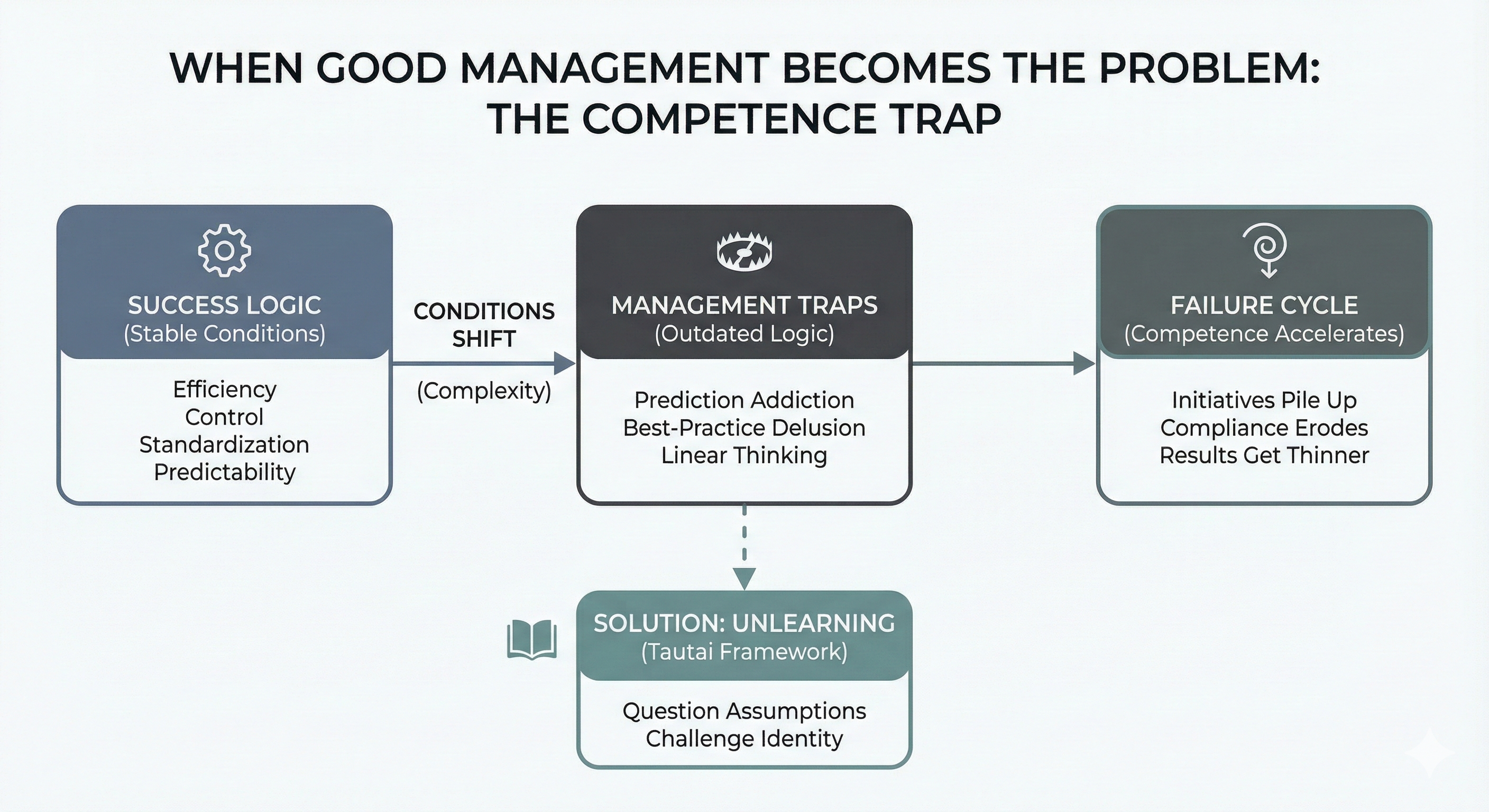
Most management practices don't fail because they are wrong. They fail because they outlive the conditions that made them successful.
That's why failure often feels so confusing. The very things that once drove performance—efficiency, control, standardization, predictability—slowly begin to produce the opposite effect.
The Pattern No One Sees Coming
You can see the symptoms everywhere: initiatives pile up, but nothing really changes. People comply, but commitment erodes. Leaders push harder, results get thinner.
This isn't incompetence. It's what happens when success logic turns into a constraint.
In Part 2, I described the distinction between complicated and complex situations. Management traps are what happens when organizations keep applying complicated logic long after their environment has shifted toward complexity. The mismatch isn't obvious—because the practices still look responsible.
The Three Traps
These traps don't look like mistakes. They look like good management.
Prediction Addiction is the belief that with enough data and analysis, you can predict and control the future. It worked when markets were stable. In volatile conditions, it creates false confidence and delayed responses.
The Best-Practice Delusion is the assumption that copying what worked elsewhere will work here. It ignores context. What made another organization successful emerged from their specific situation—transplanting practices without understanding conditions often produces the opposite result.
The Linear Thinking Trap assumes simple cause-and-effect in systems that don't behave linearly. It leads to interventions that trigger unintended consequences, because complex systems respond to changes in ways that straightforward analysis cannot anticipate.
Competence Accelerates Failure
The most dangerous part of these traps is that competence makes them worse. The better you are at applying outdated logic, the faster you reinforce the wrong patterns.
That's why many change initiatives stall. They try to add new practices on top of old assumptions. New tools, new frameworks, new language—but the underlying logic remains unchanged. You cannot adapt on top of assumptions that no longer fit reality.
The Work of Unlearning
In the Tautai framework, these patterns are not failures of execution. They are failures of fit—practices that once made sense, but now quietly undermine viability.
The work is not just learning something new. It is unlearning what no longer fits. And unlearning is uncomfortable. It challenges identity, not just behavior. It asks leaders to question the very competencies that built their credibility.
A Closing Question
Which management practice in your organization has outlived the context that made it successful?
This is Part 3 of a 12-part series introducing the ideas from my book, The Tautai Principle: Growing the Adaptive Organization (2025).
Next week in Part 4: Why organizations fail cognitively before they fail financially—and why your strategy problem might actually be a perception problem.
Most Failures Start Before the First Decision Is Made
The crucial distinction between complicated and complex situations determines whether planning helps or harms. Most organizations fail because they apply the wrong logic to their situation.
Organizations Fail Cognitively Before They Fail Financially
Most organizations don't lack information—they lack shared meaning. When the sensemaking loop breaks down, no amount of strategic planning compensates.
- How to work with Skills
- Your organization doesn’t need a better plan
- Most Failures Start Before the First Decision Is Made
- When Good Management Becomes the Problem
- Organizations Fail Cognitively Before They Fail Financially
- Crises Are Rarely Sudden
- Fast Organizations Can Still Be Too Slow
- Performance Can Look Great Right Before Failure
- Organizations Have an Anatomy We Rarely See
- Leadership Overload Is a Design Failure
- Innovation Fails Because of Structure, Not Ideas
- AI Won't Make Your Organization Smarter
- Adaptivity Is Not a Belief