

Leadership Overload Is a Design Failure
Download the Skill
The Tautai Principle: A 12-Part Series on Strategic Adaptivity Part 9 of 12
Why Heroic Leadership Might Be the Real Constraint
Leaders everywhere report the same thing: too many decisions, too little time, constant escalation.
This is not a talent problem. It's a design problem.
The Bottleneck at the Top
As complexity grows, decision volume explodes. The number of situations requiring judgment multiplies faster than any individual's capacity to process them.
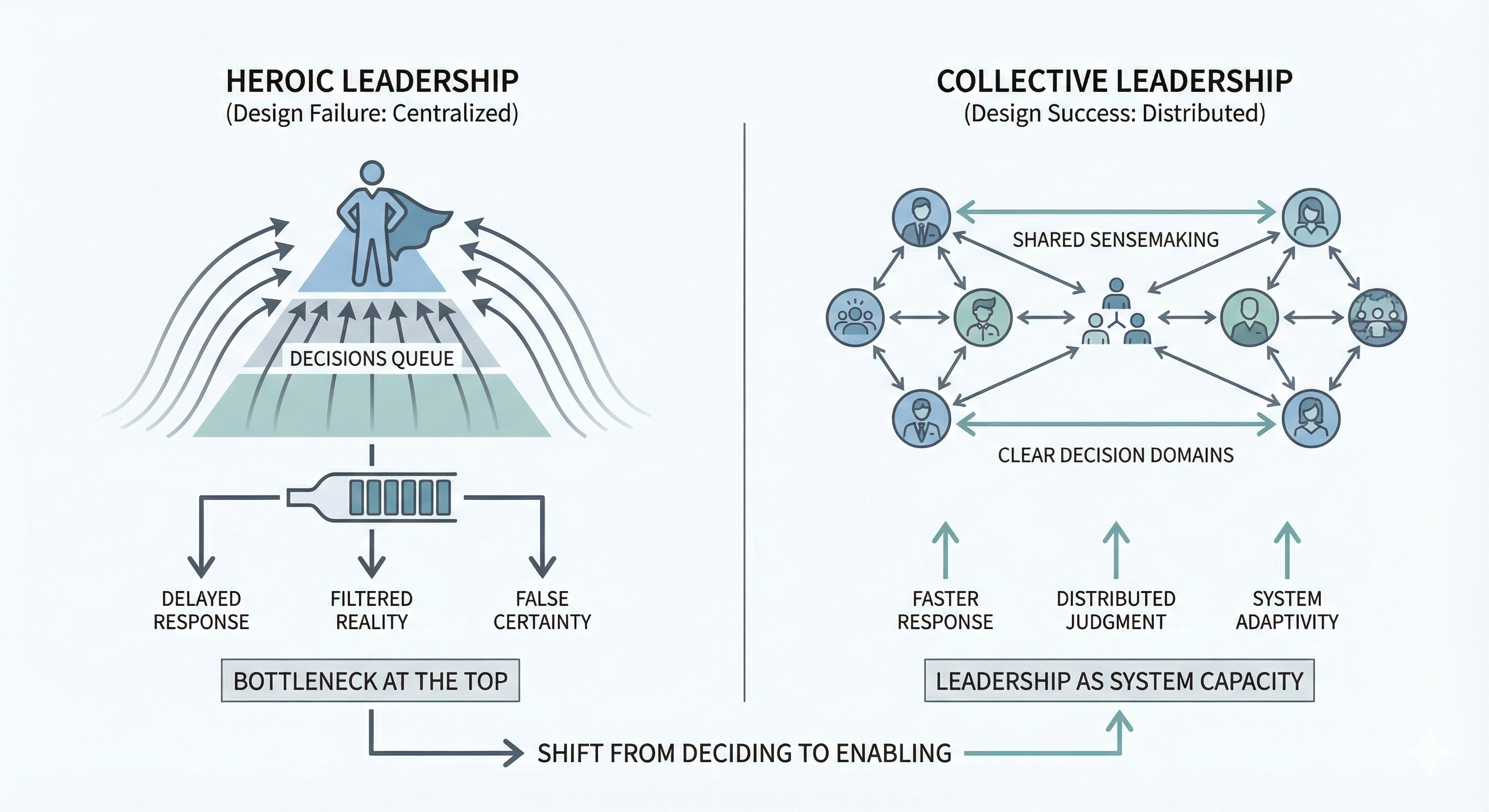
Centralizing judgment may feel safe. It preserves control. It ensures consistency. But it becomes a bottleneck under load. Decisions queue. Response times stretch. The Speed Gap I described in Part 6 widens—not because people work slowly, but because the architecture concentrates decisions where capacity is most constrained.
Heroic leadership only works when the world is slow.
What Centralization Actually Costs
In complex environments, centralized decision-making creates predictable dysfunction.
It delays response. Every decision that requires escalation adds time between signal and action. In volatile conditions, that delay can mean the difference between adaptation and obsolescence.
It filters reality. Information traveling up hierarchies gets simplified, summarized, and sanitized. By the time it reaches decision-makers, the nuance that would inform good judgment has been lost. This connects directly to Part 4's sensemaking challenge—centralization degrades perception.
It creates false certainty at the top. Leaders receive confident summaries of situations that are actually ambiguous. They decide based on clarity that doesn't exist in reality.
Collective Leadership Is Not Leaderless
The alternative is not leaderless organizations. Removing hierarchy doesn't solve the problem—it often creates new ones.
The alternative is collective leadership: distributed sensemaking that maintains perception across the organization, clear decision domains that match authority with proximity to reality, and judgment exercised closer to where situations actually unfold.
This is what I call Adaptive Decision-Making—one of the four capabilities that enable Strategic Adaptivity. It's not about eliminating leadership. It's about distributing leadership capacity so the system can respond at the speed reality demands.
Leaders don't disappear. Their role shifts—from deciding everything to enabling the organization to decide well.
The Development Trap
The trap is developing better leaders without changing the system they are trapped in.
Organizations invest in leadership programs, coaching, executive development. These investments can build individual capability. But if the structure still funnels every significant decision upward, improved individual leaders simply become more capable bottlenecks.
In Part 8, I described the Viable System perspective—the functional requirements for organizational viability. Leadership is one of those functions. But it's not a role. It's a capacity of the organization. Building that capacity means designing systems where leadership is distributed, not concentrated.
A Closing Question
Where is leadership overloaded because decisions are too centralized?
This is Part 9 of a 12-part series introducing the ideas from my book, The Tautai Principle: Growing the Adaptive Organization (2025).
Next week in Part 10: Why innovation labs don't change organizations—and what actually allows novelty to enter and survive.
Organizations Have an Anatomy We Rarely See
Some organizations absorb shocks and adapt, others collapse under mild stress. The difference is structure—vital functions that org charts hide but viability requires.
Innovation Fails Because of Structure, Not Ideas
Most organizations want innovation but place it inside structures designed for efficiency. When exploration competes with exploitation, efficiency wins—and novelty dies.
- How to work with Skills
- Your organization doesn’t need a better plan
- Most Failures Start Before the First Decision Is Made
- When Good Management Becomes the Problem
- Organizations Fail Cognitively Before They Fail Financially
- Crises Are Rarely Sudden
- Fast Organizations Can Still Be Too Slow
- Performance Can Look Great Right Before Failure
- Organizations Have an Anatomy We Rarely See
- Leadership Overload Is a Design Failure
- Innovation Fails Because of Structure, Not Ideas
- AI Won't Make Your Organization Smarter
- Adaptivity Is Not a Belief