

AI Won't Make Your Organization Smarter
Download the Skill
The Tautai Principle: A 12-Part Series on Strategic Adaptivity Part 11 of 12
Where Artificial Intelligence Helps—and Where Humans Remain Essential
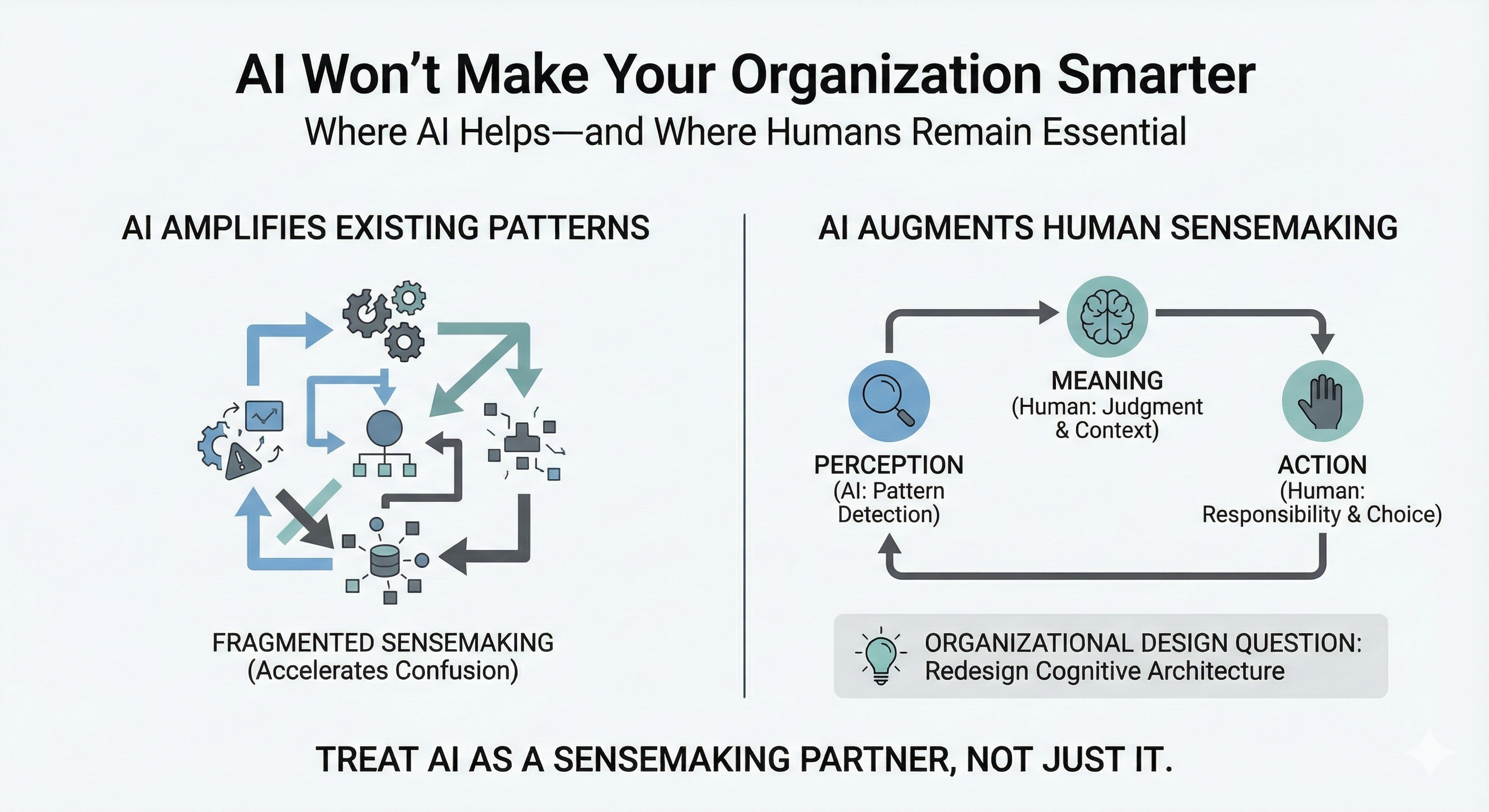
AI will make your organization more itself.
It amplifies patterns that already exist: good and bad, clear and confused. Organizations with strong sensemaking will sense better. Organizations with fragmented perception will fragment faster.
The Automation Reflex
Most AI initiatives focus on automation and efficiency. That's understandable. Automation offers clear ROI, measurable outcomes, and familiar implementation patterns.
It's also limited.
The deeper leverage lies in sensemaking: seeing earlier, interpreting better, acting sooner. In Part 4, I described the sensemaking loop—perception → meaning → action. AI's most significant potential is not replacing human work but augmenting that loop.
Different Strengths, Different Roles
AI excels at pattern detection and signal amplification. It can process volumes of information that exceed human capacity. It can surface anomalies, identify weak signals, and detect patterns that would otherwise remain invisible.
In Part 5, I described weak signals—the early indicators that organizations tend to filter out. AI can help here. It can notice what humans miss, flag what doesn't fit, and maintain attention across data streams that no individual could monitor.
But AI does not create meaning. It does not exercise judgment about what matters. It does not take responsibility for decisions or their consequences. These remain human functions.
The question is not what AI can replace. It's where AI should augment human sensemaking—extending perception while preserving the human capacity for interpretation and choice.
The Amplification Problem
Without cognitive redesign, AI accelerates confusion instead of clarity.
If an organization's sensemaking is already fragmented—if perception is filtered, meaning is contested, and action is delayed—AI will amplify those patterns. More data will create more noise. Faster processing will accelerate misdirection. Pattern detection will surface signals that the organization lacks the capacity to interpret.
This connects to Part 6's Speed Gap. AI can close the gap between signal detection and information availability. But the gap between information and meaningful action depends on organizational capacity—decision structures, interpretation processes, coordination mechanisms. AI doesn't solve those problems. It exposes them.
An Organizational Design Question
That's why AI strategy is not an IT topic. It's an organizational design question.
The relevant questions are not primarily technical. They're structural: Where does sensemaking currently break down? How will AI-generated signals be interpreted? Who exercises judgment when AI surfaces ambiguity? How will faster information flow interact with existing decision processes?
Organizations that treat AI as a technology implementation will capture efficiency gains. Organizations that treat AI as a sensemaking partner—and redesign their cognitive architecture accordingly—will build genuine adaptive advantage.
A Closing Question
Where could AI help your organization see reality earlier—not just work faster?
This is Part 11 of a 12-part series introducing the ideas from my book, The Tautai Principle: Growing the Adaptive Organization (2025).
Next week in Part 12: How fit is your organization—really? Why transformation needs diagnostics, and why readiness matters more than ambition.
Innovation Fails Because of Structure, Not Ideas
Most organizations want innovation but place it inside structures designed for efficiency. When exploration competes with exploitation, efficiency wins—and novelty dies.
Adaptivity Is Not a Belief
Most organizations claim to be adaptive but few ever test it. Fitness shows under pressure—and transformation needs diagnostics before prescribing solutions.
- How to work with Skills
- Your organization doesn’t need a better plan
- Most Failures Start Before the First Decision Is Made
- When Good Management Becomes the Problem
- Organizations Fail Cognitively Before They Fail Financially
- Crises Are Rarely Sudden
- Fast Organizations Can Still Be Too Slow
- Performance Can Look Great Right Before Failure
- Organizations Have an Anatomy We Rarely See
- Leadership Overload Is a Design Failure
- Innovation Fails Because of Structure, Not Ideas
- AI Won't Make Your Organization Smarter
- Adaptivity Is Not a Belief