Innovation Fails Because of Structure, Not Ideas
Download the Skill
The Tautai Principle: A 12-Part Series on Strategic Adaptivity Part 10 of 12
Why Innovation Labs Don't Change Organizations
Most organizations claim they want innovation. Then they place it inside structures designed for efficiency.
That conflict is fatal.
Two Logics That Cannot Share Space
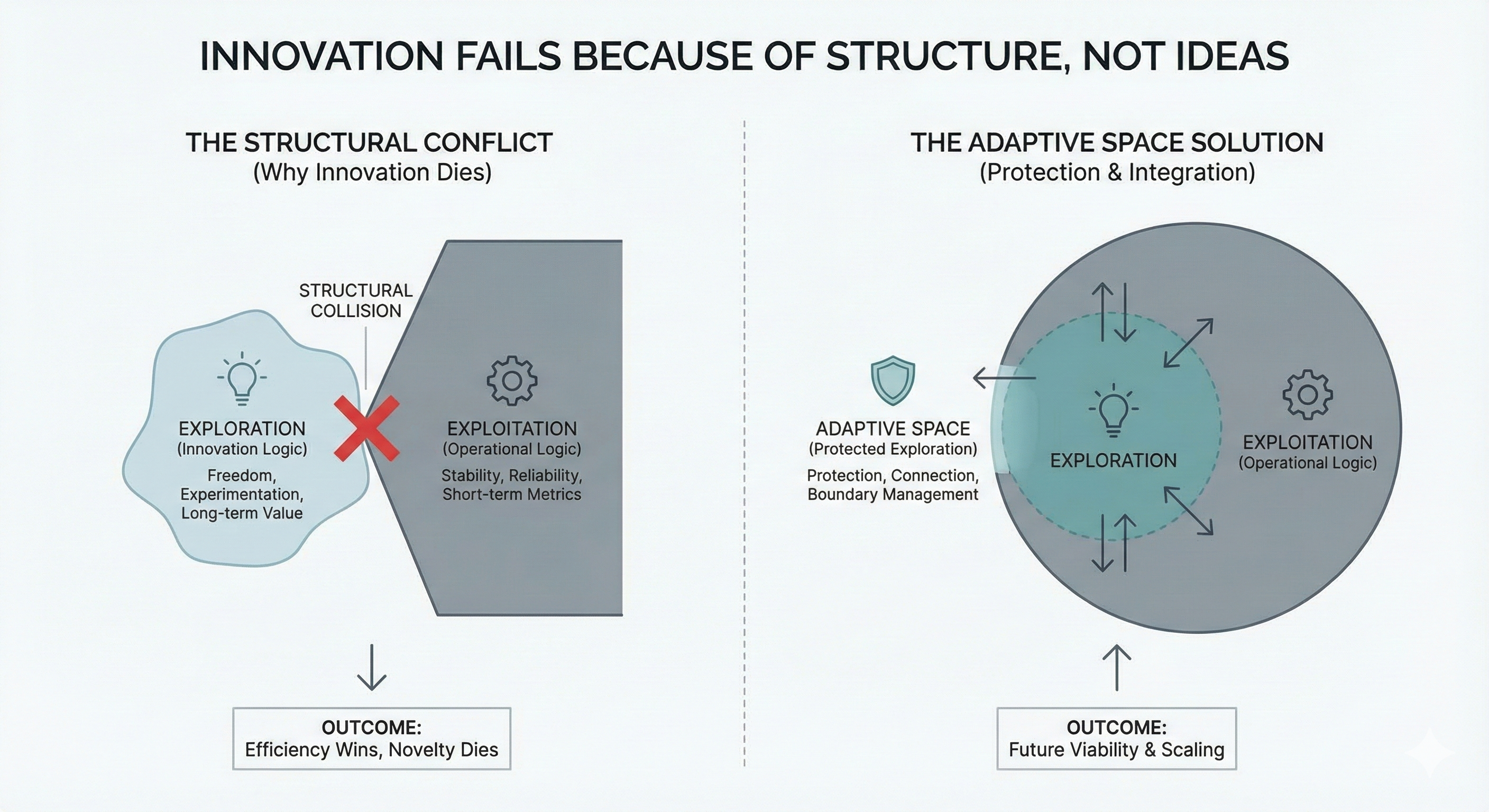
Exploration and exploitation follow different logics.
Exploration needs freedom to experiment, protection from immediate performance pressure, and time to develop ideas that don't yet prove their value. Operations need stability, reliability, and predictability. Both are legitimate. Both are necessary.
But when both are forced into the same space, exploration loses. Every time.
Operational logic is stronger. It has clearer metrics, shorter feedback cycles, and more immediate accountability. When exploration competes with exploitation for attention, resources, or legitimacy, efficiency wins—and novelty dies.
Why Good Ideas Never Scale
This structural collision explains patterns that frustrate leaders everywhere.
Pilots stall because they succeed in protected conditions, then fail when exposed to operational pressure. Innovation labs isolate because they're designed to stay separate—but separation prevents integration. Good ideas never scale because the path from exploration to implementation runs through hostile territory.
In Part 3, I described management traps—practices that outlive their context. Innovation failure is often a trap in action: the efficiency logic that made the organization successful now prevents it from developing new sources of value.
Adaptive Space
Adaptive organizations solve this by creating what I call Adaptive Space: protected environments for exploration that remain connected back to the core.
This is not chaos. It's design.
Adaptive Space has specific characteristics. It provides protection—shielding exploration from premature efficiency pressure. It maintains connection—ensuring that what emerges can actually influence the organization. And it manages the boundary—controlling how and when new approaches integrate with existing operations.
The distinction matters. Innovation labs that isolate completely never change the organization. Innovation forced into operational structures never survives. Adaptive Space is the structural solution that enables both protection and integration.
The Celebration Trap
The trap is celebrating innovation without protecting it from efficiency logic.
Organizations announce innovation initiatives, fund labs, hire creative talent—then wonder why nothing changes. The problem is not commitment. The problem is that exploration requires structural protection, and most organizations provide visibility without viability.
This connects to Part 7's distinction between performance and viability. Innovation is a viability investment. It doesn't optimize current performance—it builds future capacity. Treating it with performance logic guarantees its failure.
A Closing Question
Innovation doesn't fail because of ideas. It fails because of structural collision.
Where is exploration forced to survive in hostile territory?
This is Part 10 of a 12-part series introducing the ideas from my book, The Tautai Principle: Growing the Adaptive Organization (2025).
Next week in Part 11: AI won't make your organization smarter—unless you change this. Where artificial intelligence helps, and where humans remain essential.
Leadership Overload Is a Design Failure
Leaders report too many decisions and constant escalation. This is not a talent problem—it's a design problem. Heroic leadership only works when the world is slow.
AI Won't Make Your Organization Smarter
AI amplifies patterns that already exist—good and bad. Without cognitive redesign, AI accelerates confusion instead of clarity. AI strategy is an organizational design question.
- How to work with Skills
- Your organization doesn’t need a better plan
- Most Failures Start Before the First Decision Is Made
- When Good Management Becomes the Problem
- Organizations Fail Cognitively Before They Fail Financially
- Crises Are Rarely Sudden
- Fast Organizations Can Still Be Too Slow
- Performance Can Look Great Right Before Failure
- Organizations Have an Anatomy We Rarely See
- Leadership Overload Is a Design Failure
- Innovation Fails Because of Structure, Not Ideas
- AI Won't Make Your Organization Smarter
- Adaptivity Is Not a Belief