

Adaptivity Is Not a Belief
Download the Skill
The Tautai Principle: A 12-Part Series on Strategic Adaptivity Part 12 of 12
How Fit Is Your Organization—Really?
Most organizations claim to be adaptive. Few ever test it.
Fitness Shows Under Pressure
Fitness is not about ambition or culture statements. It's not about what the strategy deck promises or what leaders believe. It shows under pressure.
When reality shifts, do you notice in time? When signals emerge, do you interpret them coherently? When action is needed, do you respond fast enough? When you act, do you learn from what happens?
Throughout this series, I've described the components that determine these answers. Sensemaking in Part 4. Weak signal detection in Part 5. The Speed Gap in Part 6. Viability in Part 7. Structural requirements in Part 8. Decision distribution in Part 9. Each piece contributes to organizational fitness—the capacity to remain viable under changing conditions.
Heroics vs. Design
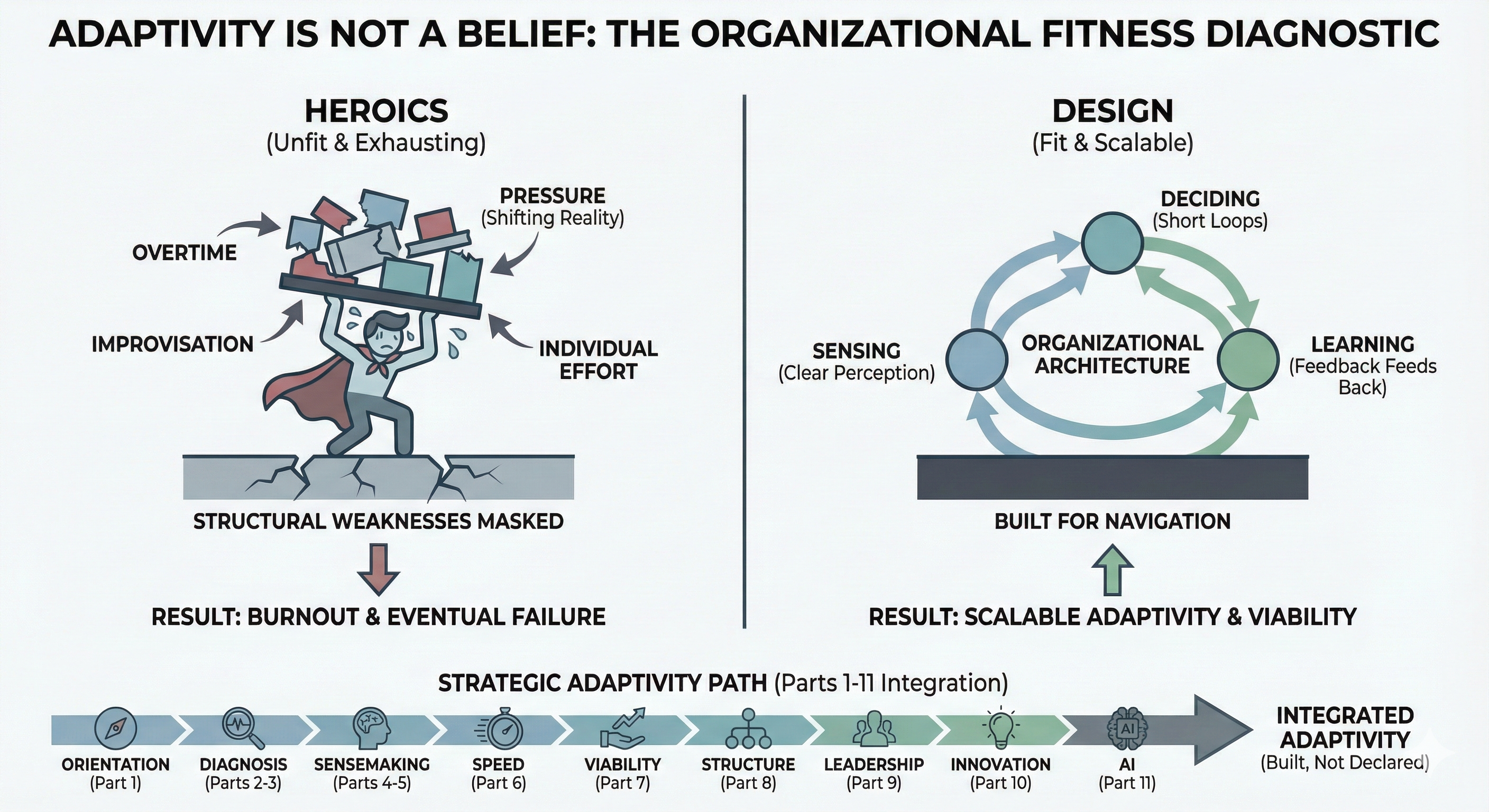
Unfit organizations rely on heroics. When pressure mounts, they depend on overtime, improvisation, and individual effort. Leaders absorb the strain. Teams push harder. The organization survives through exhaustion.
This works until it doesn't. Heroics cannot scale. They burn out the people who carry them. And they mask structural weaknesses that compound over time.
Fit organizations rely on design. Clear sensing that maintains perception across the organization. Short decision loops that keep Response Time competitive. Feedback that actually feeds back—learning that changes behavior, not just generates reports.
The difference is not willpower. It's architecture.
Transformation Needs Diagnostics
The trap is launching transformation without diagnosis.
Organizations announce change initiatives, adopt new frameworks, reorganize structures—without first understanding where fitness actually fails. The result is expensive movement. Activity without improvement. Change without adaptation.
Before changing anything, it's worth asking: Where are we unfit—and why?
This requires honest assessment. Not optimistic self-evaluation, but systematic examination of sensing capability, decision speed, learning effectiveness, and structural adequacy. In the Tautai framework, this is the Organizational Fitness Test—a diagnostic that identifies specific gaps before prescribing solutions.
Building Adaptivity Deliberately
Strategic Adaptivity—the ability to sense market shifts and respond weeks faster than competitors—is not declared. It's built.
Over the past twelve weeks, I've traced the path from orientation to diagnosis to redesign. From breaking the assumption that planning is enough (Part 1), through understanding complexity (Part 2), recognizing management traps (Part 3), building sensemaking capacity (Parts 4-5), closing the Speed Gap (Part 6), distinguishing performance from viability (Part 7), understanding structural requirements (Part 8), distributing leadership (Part 9), protecting innovation (Part 10), and integrating AI thoughtfully (Part 11).
Each piece matters. None is sufficient alone. Adaptivity emerges from their integration—from organizations that design for navigation rather than hoping it happens.
A Final Question
If reality changed faster tomorrow, would your organization notice in time?
This is Part 12 of a 12-part series introducing the ideas from my book, The Tautai Principle: Growing the Adaptive Organization (2025).
The series is complete. For those who want to go deeper—into the frameworks, the diagnostics, and the implementation path—the book is available now. Thank you for reading.
- How to work with Skills
- Your organization doesn’t need a better plan
- Most Failures Start Before the First Decision Is Made
- When Good Management Becomes the Problem
- Organizations Fail Cognitively Before They Fail Financially
- Crises Are Rarely Sudden
- Fast Organizations Can Still Be Too Slow
- Performance Can Look Great Right Before Failure
- Organizations Have an Anatomy We Rarely See
- Leadership Overload Is a Design Failure
- Innovation Fails Because of Structure, Not Ideas
- AI Won't Make Your Organization Smarter
- Adaptivity Is Not a Belief