Organizations Have an Anatomy We Rarely See
Download the Skill
The Tautai Principle: A 12-Part Series on Strategic Adaptivity Part 8 of 12
Why Some Organizations Survive Everything—and Others Don't
Some organizations absorb shocks and adapt. Others collapse under surprisingly mild stress.
The difference is rarely culture. It is structure.
The Functions You Cannot Remove
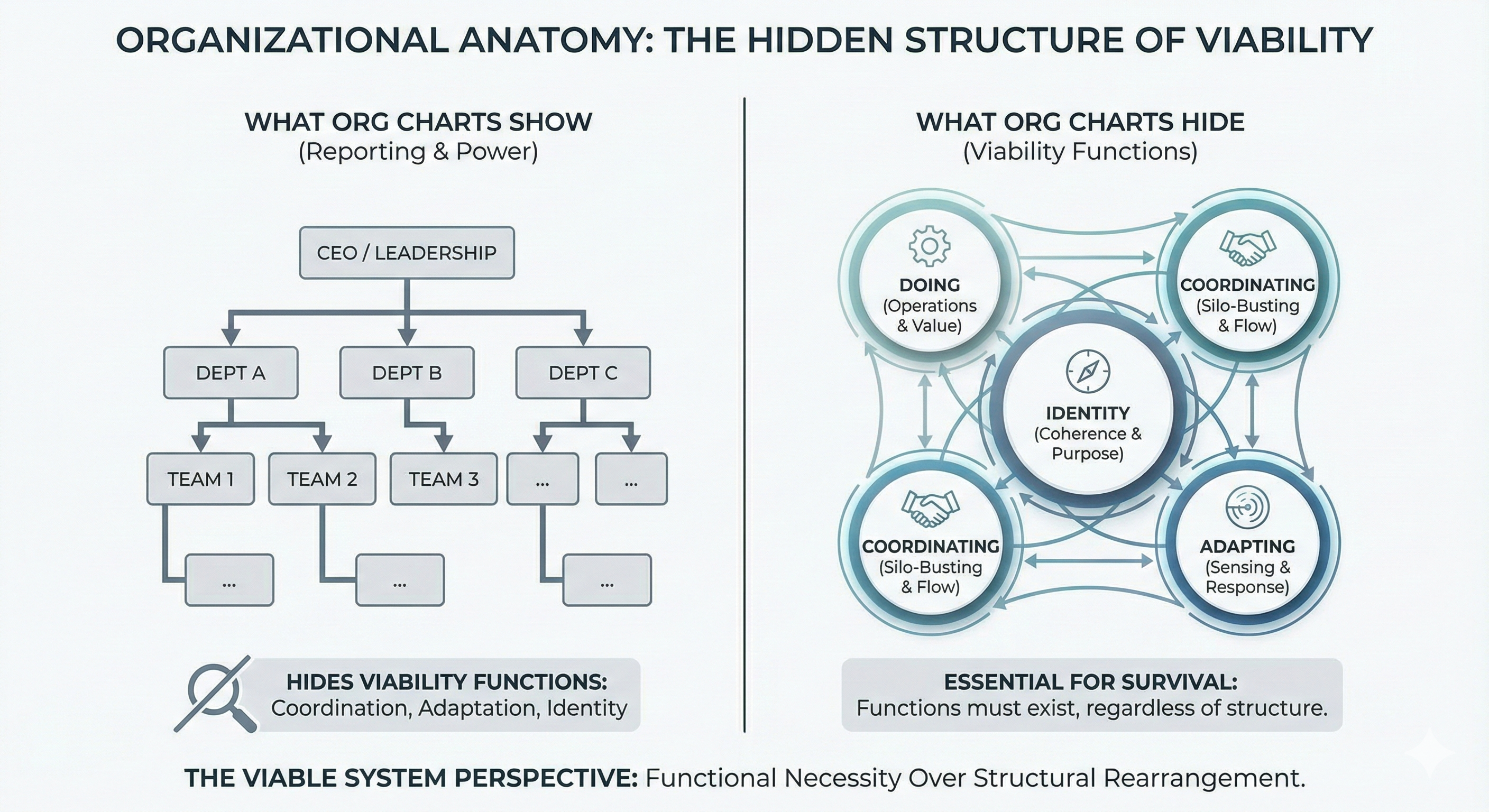
Every viable organization must perform a small set of functions: doing the work, coordinating the work, adapting the work, and maintaining identity across time.
You can rename them. You can distribute them across different roles or teams. You cannot remove them.
In Part 7, I described the difference between performance and viability. Viability is not abstract—it has structural requirements. These functions are the minimum conditions. When any one of them is missing or overloaded, the organization loses its capacity to survive under changing conditions.
What Org Charts Hide
Most org charts show reporting lines and power. They show who reports to whom, who has authority, who controls resources.
They hide viability functions.
An organization can have a clear hierarchy and still lack adequate coordination. It can have strong operational units and no functioning adaptation mechanism. It can execute well and have no coherent identity guiding choices.
When one of these functions is overloaded or missing, problems appear elsewhere: burnout from coordination gaps, misalignment from identity drift, strategic confusion from inadequate adaptation. The symptoms look like people problems. The cause is structural.
Why Reorganizations Disappoint
This is why reorganizations so often disappoint. They change boxes. They move people. They redraw lines.
They rarely address functions.
A reorganization that doesn't ask "How will coordination actually happen?" or "Where does adaptation live?" or "What maintains identity across these changes?" will reproduce the same problems in new configurations. The structure looks different. The dysfunction persists.
The Viable System Perspective
In the Tautai framework, I draw on an adapted Viable System perspective. Viability is not a matter of preference or organizational philosophy. It's a matter of functional necessity.
Certain things must happen for an organization to remain viable: operations must deliver value, coordination must prevent conflict, adaptation must sense and respond to change, identity must provide coherence. These functions exist whether they're designed or not—the question is whether they're adequate.
This connects to Part 6's Speed Gap and Part 4's sensemaking loop. Adaptation as a function depends on sensing capability and response speed. When that function is weak or absent, the organization drifts toward obsolescence regardless of operational excellence.
A Closing Question
Structure is not bureaucracy. Structure is survival architecture.
Which vital function in your organization is invisible or overwhelmed?
This is Part 8 of a 12-part series introducing the ideas from my book, The Tautai Principle: Growing the Adaptive Organization (2025).
Next week in Part 9: Why leadership overload is a design flaw, not a people problem—and why heroic leadership might be the real constraint.
Performance Can Look Great Right Before Failure
Most organizations manage for performance, few for viability. An organization can hit every target while losing the capacity to adapt—and by then, the window for response has narrowed.
Leadership Overload Is a Design Failure
Leaders report too many decisions and constant escalation. This is not a talent problem—it's a design problem. Heroic leadership only works when the world is slow.
- How to work with Skills
- Your organization doesn’t need a better plan
- Most Failures Start Before the First Decision Is Made
- When Good Management Becomes the Problem
- Organizations Fail Cognitively Before They Fail Financially
- Crises Are Rarely Sudden
- Fast Organizations Can Still Be Too Slow
- Performance Can Look Great Right Before Failure
- Organizations Have an Anatomy We Rarely See
- Leadership Overload Is a Design Failure
- Innovation Fails Because of Structure, Not Ideas
- AI Won't Make Your Organization Smarter
- Adaptivity Is Not a Belief