

Using the VSM
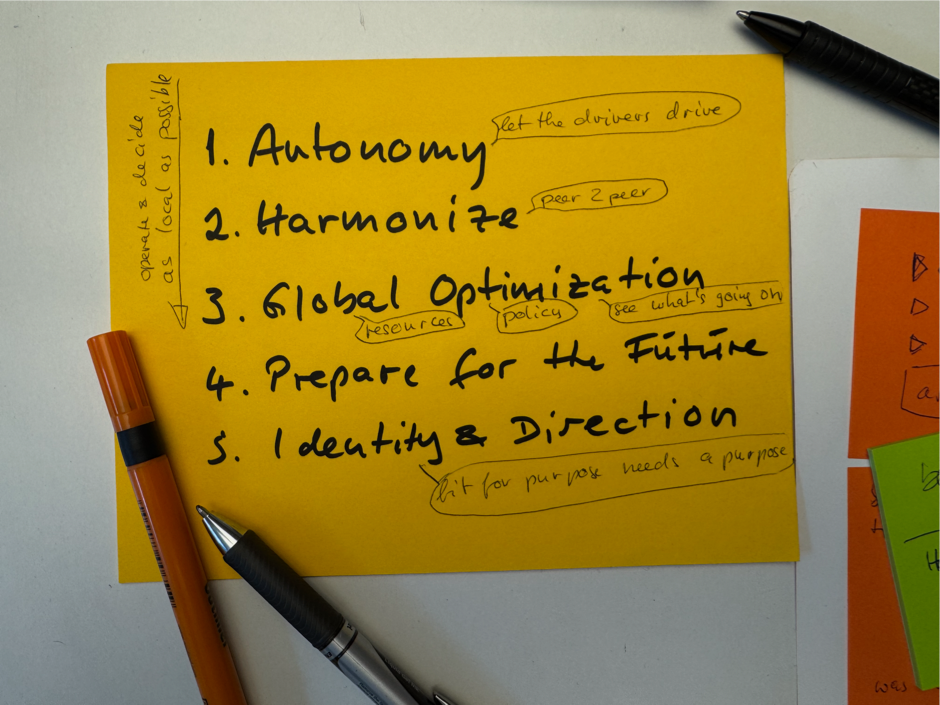
The VSM derives from its cybernetic roots several clear guidelines for a viable organization
These are reflected in
- The axioms of management, as Stafford Beer called them. These could be regarded as basic design rules.
- In the description of pathologies, i.e. the design and relationship of systems that are dysfunctional and lead to inefficiencies and other symptoms
The five Axioms of Management
Below are five key axioms of management as applied in the Viable System Model. These axioms form the foundation for designing and managing organizations so they can remain adaptive, resilient, and effective in a changing environment. They ensure that an organization can effectively process the complexity of its environment.
1. Axiom of Requisite Variety
A system must have a control mechanism with sufficient variety to manage the range of challenges posed by its environment.
In practice, this means that the decision‐making structures (e.g., management or control systems) must be as complex as the challenges they face. For instance, in a soccer club, the sports science team and performance analysts (System 3*) need to capture and process a wide range of data (from player fitness to match statistics) to support informed decisions.
2. Axiom of Recursion
Every viable system is composed of smaller viable subsystems and is itself embedded in a larger viable system.
This recursive nature implies that each operational unit (e.g., a team in a soccer club) must be organized as a viable system, using the same methods as the design of the whole organization. It helps ensure that each unit can operate independently while still aligning with the broader strategy set by the club's board (System 5).
3. Axiom of Autonomy and Coordination
Operational units should be as autonomous as possible, but they must also be coordinated to work toward common goals.
In the VSM, this balance is achieved by granting operational units (System 1) the freedom to execute their specific tasks (like training sessions and match preparations) while using coordination mechanisms (System 2) to align their activities. For example, separate training schedules for the first team, reserve team, and youth academy must be coordinated so that the overall club strategy is maintained.
4. Axiom of Control and Accountability
There must be a management system that monitors, optimizes, and intervenes when necessary to maintain overall organizational performance.
This is embodied in Systems 3 and 3*, which oversee operations by setting policies, allocating resources, and gathering feedback through audits and performance reviews. In a soccer club, club management and board ensure that match-day logistics, player contracts, and financial operations align with the club's long-term vision.
5. Axiom of Policy and Identity
A clear organizational identity and set of policies are essential to guide all decisions and maintain coherence throughout the system.
System 5 in the VSM establishes the club's vision, mission, and strategic objectives, ensuring that every decision---from tactical choices on the pitch to strategic investments off it---supports the club's core identity. This might be seen in how a club preserves its tradition, values, and brand while adapting to new challenges.