

The Viable System Model (VSM)
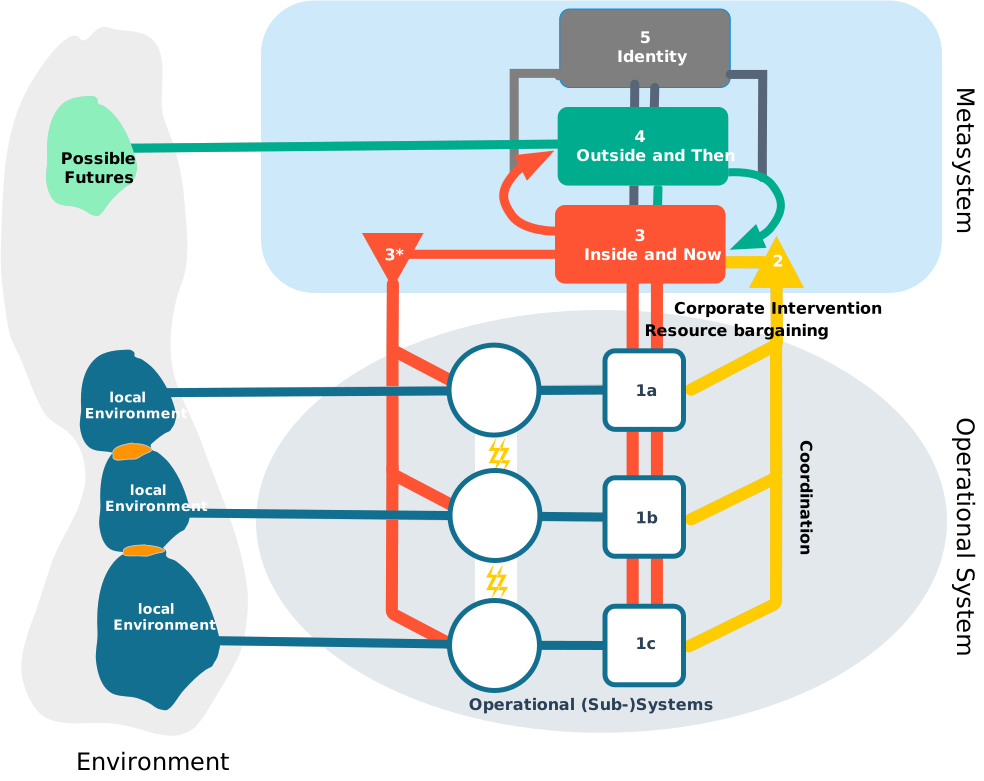
VSM: a cybernetic model for the organization
The Viable System Model (VSM), developed by the British cyberneticist Stafford Beer in the late 1950s, implements cybernetics principles for the organization.
Cybernetics, in general, is the study of command and control. Cybernetic "machines" are technical, biological, or sociological entities that stabilize with feedback loops in interaction with their environment. Since its development in the 1940s, Cybernetics has gained widespread use in fields ranging from biology to psychology, sociology, and military engineering.
The VSM describes the organization in interaction with its environment (analogous to an ecological niche) and the elements ("organs") necessary for it to function and secure its future. It is capable of self-steering, interacting, and evolving with its environment.
The VSM concentrates on decision-making and communication processes in the organization. It brings a third perspective to the organization, in addition to the hierarchical and workflow organization. It improves organizational sustainability and viability. It provides a comprehensive framework that enables organizations to understand and optimize their internal decision-making and information processes.
The Emergence of the VSM
The Viable System Model's genesis began with Stafford Beer's work on management and organizational issues. He felt that traditional organizations were often inefficient and inflexible and had difficulty adapting to an ever-changing environment. He saw the need to develop a self-regulating, adaptable organizational structure to deal with uncertainty and complexity.
In the 1970s, Beer conducted intensive studies of numerous organizations, including corporations, government agencies, and social institutions. He analyzed their structures and functional processes and realized that successful organizations had some common characteristics that helped them survive and thrive in a complex environment.
One of the most ambitious use cases was in 1971-1973 for the democratically elected socialist government of Salvador Allende in Chile. Allende wanted to develop a functional control system for the country's nationalized mining and banking industries.
Since then, the model has been applied to a wide range of applications in highly diverse organizations, from large corporations in crises to healthcare systems to structuring social movements.^1
Evidence of the Impact of the VSM
There is a lot of practical experience in organizations of every type, and solid academic research to support the bold claim of the VSM
1 Enhanced Diagnosis and Design of Organizations
VSM has demonstrated significant diagnostic power in identifying weaknesses and opportunities for improvement in organizational structures, aiding in their redesign to better cope with environmental complexity (Schwaninger 2006)
It supports the creation of systems that are both autonomous and adaptable, ensuring viability by addressing critical variables and ensuring effective communication channels (Leonard 2009).
2 Applications in Diverse Contexts
The model has been successfully applied in areas ranging from higher education to software development and sustainability practices, showcasing its versatility (Rezk and Gamal 2019), (Kawalek and Wastell 2002). (Leonard 2007), (Espinosa Salazar and Walker 2017), (Espinosa 2022).
3 Improved Management Practices
By facilitating better alignment between organizational activities and environmental demands, VSM enables managers to address complexity effectively. This is particularly valuable in highly dynamic industries (Hildbrand and Bodhanya 2013)
The model encourages systemic thinking, which is crucial for addressing interconnected challenges (Espejo 1990).
4 Empirical Validation
Studies have empirically validated VSM's principles, showing its effectiveness in fostering organizational viability and resilience (Schwaninger and Scheef 2016).