Introducing the VSM
The VSM is recursive.
The VSM can be applied to different levels, each of which consists of viable units. The levels do not mean the same as hierarchy but levels of abstraction, e.g., team, value stream, portfolio, total company. The VSM can be applied to any of these levels, but one chooses one of these levels of abstraction for a given analysis.
At this chosen abstraction level (in VSM-speak: „System in Focus"), in addition to the system itself, the relationships to the neighboring and embedded systems, as well as the relationships to the environment and the next higher abstraction level, are analyzed or modeled.
The VSM can be used to analyze or design the system-in-focus. An analysis or diagnosis of dysfunctionalities uncovers organizational problems, while a design involves a much deeper intervention.
With VSM, the choice of the intensity of the intervention and the system in focus can very well influence how large the "blast radius" of a measure will be. This means an essential advantage for risk management in a change process.
The VSM vocabulary
The VSM closely follows the vocabulary of Cybernetics; therefore, we will find some of the vocabulary described above but with a slightly more specialized meaning.
The Subsystems
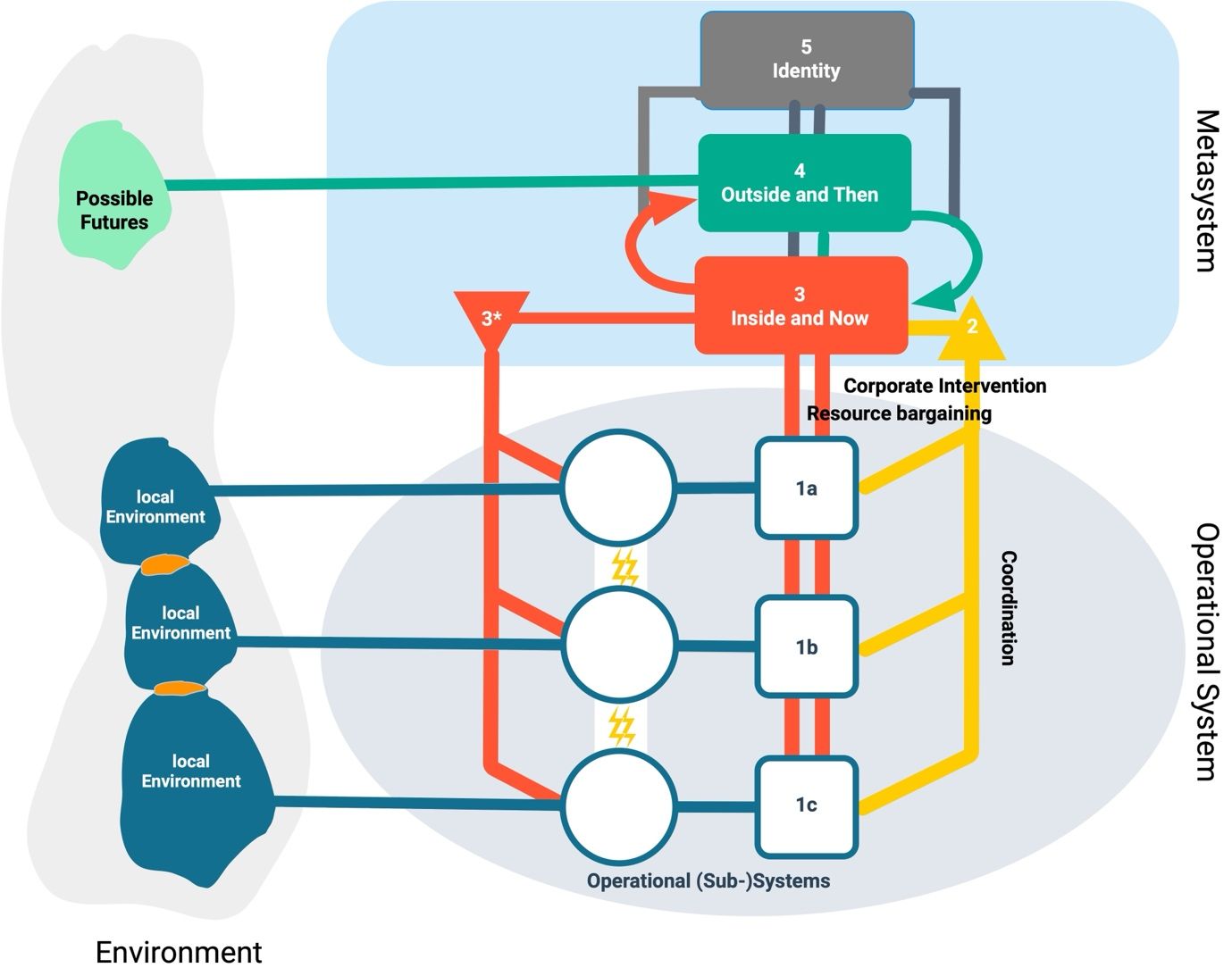
In the VSM vocabulary, there are different systems - systems 1 to 5 - and several channels (communication paths) between them. The notation is initially confusing because these five systems do not always mean parts of the organization but rather denote points of view or perspectives.
There is also more behind the channels than it first appears. We will elaborate on that as well.
The different subsystems are:
System 1: The operational system, productive work, value creation
System 2: day-to-day coordination of the individual systems 1. This includes things as diverse as secretarial services, standards of conduct, or software version management.
System 3: Planning and organization of work. This includes the stabilizing aspects (in VSM-speak: "inside and now") such as controlling, compliance, and marketing, which can be called operational management.
System 4: New development, market research, new developments. These are the future-oriented aspects (in VSM-speak, "outward and future," "Outside and Then":) that help the organization to prepare for future challenges
System 5: Identity, prioritization: the ultimate boss. Maintaining identity moderates between the conflicting demands of the subsystems mentioned above. System 5 keeps the overall system in mind. This is the organization's ultimate goal, and with it, System 5 can act on the other subsystems in an emergency.
In addition
System 3* (three-star): active information gathering
Another distinction is between the operational system (System 1) and the metasystem (collectively, the other systems). This is analogous to the distinction between „value-creating" and „necessary overhead " parts in Lean Thinking-
System and meta-system
"Any sufficiently powerful, recursively enumerable formal system is either contradictory or incomplete." - Gödel^2
Gödel's theorem is virtually hard-wired into the VSM: a system cannot fully describe itself, so a meta-system contributes to self-reflection: systems 1 represent the operational work, while systems 2 through 5 form the meta-system or management.
When examining individual systems, one must never forget that they are functions, not roles or persons.
The VSM diagram should not be read as an organizational chart but as a network of decision-making and communication paths. A better metaphor than an organizational chart would be to compare it to a nervous system.
The VSM Model
Suborganizations are viable systems.
We have already introduced that the VSM is recursive, meaning that the principles can be applied to the overall organization and the system-in-focus. For an analysis or design, you need to focus on one entity.
The VSM requires the entire system and its Systems 1, the operational units, to be viable. This applies, for example, to a company, its various value streams, and, in turn, the various teams that make up the value streams.
Consequently, VSM can be used to describe the different levels of an organization using the same methods and to gain insights from them. This opens up immense sound analysis and design possibilities at each level.
Only Systems 1 must be viable.
An important note is here: only Systems 1 must be viable and can be represented again as a complete VSM in an "exploded view." This is especially not true for Systems 3 to 5 or their functional elements, such as marketing or controlling.
On the contrary, if these functions develop a life of their own and isolated objectives, this is a dysfunction in the organization, and the various objectives will soon conflict.
Channels in VSM
In VSM, channels occur as
- Vertical channels between the metasystem and the operational units
- The resource bargaining/accountability channel for resource allocation and accountability for performance and results
- The inquiry channel of System 3* to fight blind spots and keep management in contact with reality
- The corporate intervention channel - maintaining the coherence of the organization
- The algedonic channel: sensing emergencies and the last resort of intervention by System 5 in case of extraordinary danger or opportunities
- Horizontal channels between parallel operational systems. We find them in the direct interaction between parallel Systems 1 and as part of System 2.
- Channels for communication with the environment
Real-time information systems
Information must flow fast through the channels to enable effective control. The VSM emphasizes the importance of real-time information for effective decision-making and system stability.
A good information system, providing up-to-date transparency and helping to concentrate on important information, is an alternative to excessive reporting or intrusive management. It can render unnecessary organizational techniques based upon excessive management involvement.
If the appropriate information is measured and feedback is used to modify how people work, then many organizational issues take care of themselves.
This Section covers real-time information systems based on performance indicators, self-assessment using these indicators, and the generation of the alerting signals called algedonics.
Areas of Interest
If you look at the Inside and Now of your VSM diagram there are several areas in which information is crucial to good design:
The Operational units must be accountable. They must find measures of what they do and ensure that the appropriate information reaches System 3.
- System 3* does audits and surveys - it is an information service to System 3, looking at whatever is of relevance.
- System 3 must have a thorough model of everything it needs to know about the operations within the entire complex of interacting Operational units. Otherwise, it will make decisions in ignorance.
- An information system must be capable of generating alert signals so the organization can find out that something has gone wrong as soon as it happens. These signals are referred to as "algedonics".
- System 4 is charged with adapting to environmental change. It will need information about the external environment to produce strategies. It will also need a good model of internal capabilities to know what tools it has at its disposal.
All of these factors require thorough information systems.
Limit to Relevant Information
Traditionally, information systems within a business are primarily concerned with financial information. They generally involve historical figures, so after the monthly figures are produced, someone may say, "We have just realized that the business lost money last month because of something that happened in Factory 27." Of course, this is too late.
The other aspect of traditional information systems, superseded in VSM theory, is the production of huge printouts from a database, most of which are never used.
Central to the VSM approach is producing only what is essential. If the information says, "All seems to be going as usual," nothing needs to be done. Consequently, there is no point in printing the report.
The information systems used in the VSM are fundamentally different from traditional systems in that:
- They are based upon performance indicators that measure whatever is important within each operational unit, not just financial information.
- they are based upon daily measurement so that problems can be identified on the same day.
Closing the Loop
The overall principle is clear - closed loops work, and open loops don't.
We will see that closing the loop alone is not enough---it must also be closed promptly to ensure adequate reaction times.
Principles
- Data in real time: measurements should be as close to real time as possible. Traditional reporting systems based on historical data are not suitable because they only reflect past events. Real-time information enables management to respond to current conditions, thus ensuring the viability of the system.
- Reporting by exception: Instead of creating regular reports, focus on reporting by exception, i.e. only deviations from the planned values that indicate potential instability
- Algedonic signals: Algedonic signals are warning signals that are sent directly to the highest management level (system 5) when critical events occur. These signals bypass the usual information channels and enable an immediate response to critical situations.
Tools and methods
There are a number of specific tools and methods developed in the context of the VSM.
- Cyberfilter: The cyberfilter is a statistical filter system developed by Beer that monitors real-time data and generates alerts when critical values show signs of instability while avoiding false positives.
- Operation Room: The Operation Room is a concept proposed by Beer 1972 to enable the visualization and analysis of real-time data. It is a room where critical system variables are displayed in real time, together with historical data and simulation results.
- Team Syntegrity: Team Syntegrity is a structured facilitation method developed by Beer to improve communication between those responsible for strategic management (system 4) and operational management (system 3).
Advantages
Fast channels with near real-time information flow bring a number of obvious advantages for controlling a system.
- Rapid response to change: Real-time information enables companies to respond quickly to changes in their environment. [8]
- Early detection of instability: Real-time data and statistical filters enable the early detection of instability and potential crises. [9, 10]
- Improved decision-making: Real-time information provides a more accurate picture of the current situation and enables better decision-making. [11]
- Effective resource allocation: Reporting by exception and the use of Algedonian signals help to efficiently allocate resources and avoid waste. [4]
Essential Elements of an Information System
1. Performance Indicators
Negotiations are needed between the department in question and the person responsible for allocating resources. (Remember, this also involves designing the accountability systems that complete the resource-bargain loop between Systems 1 and 3.)
The question is, "What numbers do I regularly quote when discussing how well the day has gone?" For example, "Only three tonnes of muesli all afternoon." or "What a good day! I completed four pages of the ledger."
These indicators must satisfy both the department and the resource allocator to give a complete picture.
It will then be the responsibility of the department to measure and plot them every day.
2. Algedonics
Some variation will be inevitable. It may take some time to establish what an algedonic actually is. For example, a 5% variation in productivity is fine as long as the variations even out. A continuous decline for four days is unacceptable and constitutes an algedonic. A 10% variation needs to be examined. And so on.
The algedonic channel's responsiveness must be established, or it may churn out algedonics every time someone sneezes.
3. Reaction Time
Each indicator must be studied individually. You must then decide how long it should take to resolve problems and how long a problem can be permitted to continue until the viability of the whole co-operative is at risk.
So ... you have five days to deal with wastage problems, ten days to get out-of-stock back to acceptable levels, and so on.
These horizons must be agreed upon in advance, as when a crisis hits the system, the framework for dealing with it must be already established.
4. Loss of Autonomy
If an indicator becomes unacceptable and continues at that level beyond the pre-agreed time, the outer/higher unit will be notified, and that department will lose its autonomy.
Again, the nature of this loss should be designed. It may involve a complete analysis of the problem, the appointment of an agreed-upon troubleshooter, or whatever.
But again, this should be agreed in advance.
The VSM Systems
System 1: Environment, Operation, Management
The Operational System - Systems 1
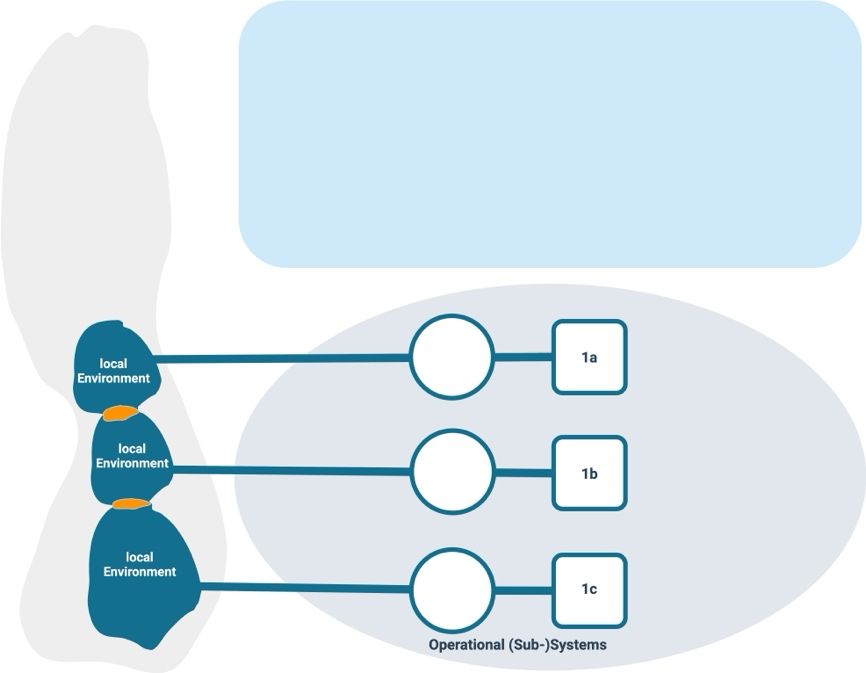
The operational system (System 1)
The most important aspect of a system is what it does. It is roughly equivalent to the value stream or value chain in Lean.
The system is what it does. Stafford Beer
In VSM, we call this aspect system one or the operational system. It describes the direct responsibility for delivering a specific service or product.
System 1 is related to its environment and needs some method to organize itself: its control system (or metasystem or management). We describe the connection between System 1 and the environment or its control system regarding communication channels.
Understanding and adequately designing communication channels is more important than the individual systems, as they essentially determine the system's functioning.
Products or services, target groups, markets, or other segmentations may each require their own operational system. Several operational systems can---and typically will---exist in an organization.
In the illustrations, one can also already observe the beginning of the ecosystem's graphic language: in fact, the operational system is represented as an oval, the control, meta, or management system as a rectangle, and the relevant environment---or the niche of the ecosystem---as an amoeba-like shape.
First insights
One view of an operational system in it ́s environment is as follows:
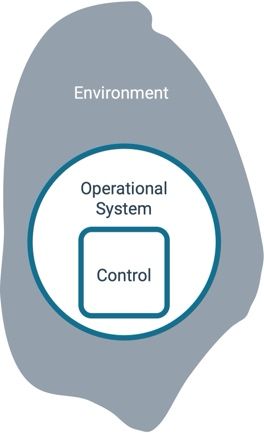
System 1 in the environment
The elements are the environment, e.g., the customers, competition, or government regulations; the operational system as the determining view ("the system is what it does"); and the control system or local organization. It means preferably self-organization, as far as possible, but in principle, any organization.
For a more detailed representation, the three aspects of system one are pulled apart to represent the channels between the elements.
It shows that besides the relations between the environment and the operative system, there are two directed communication channels between the operative system and the control system, which are also two communication channels.
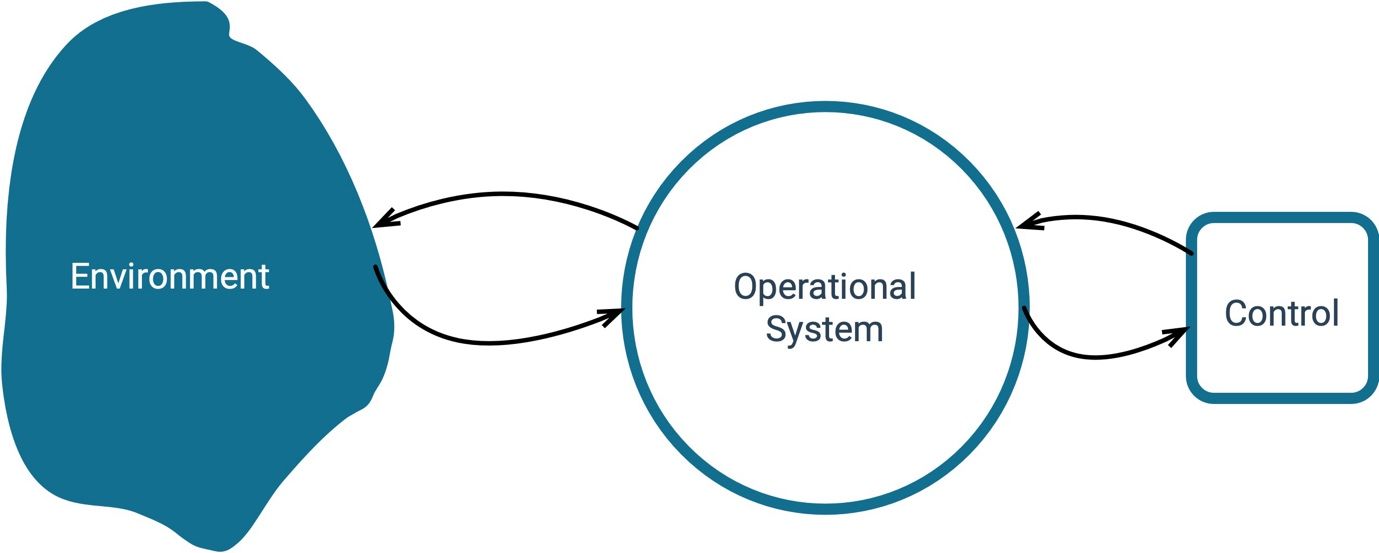
System 1 with channels
Application: a lean value stream
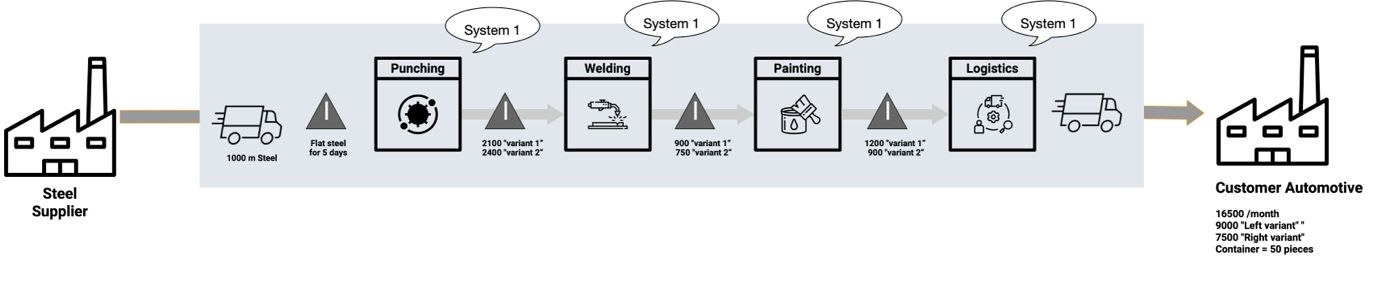
A value stream forms system 1
We use a simplified value stream of a metal processor as an example^3, as presented in Lean Production.
The value stream shows the flow of the processed material through the individual processing stations. Between the stations, you can see the stock.
Thus, we have the concrete system 1. Next, we introduce elements of the other VSM subsystems one by one.
System 2: Daily coordination
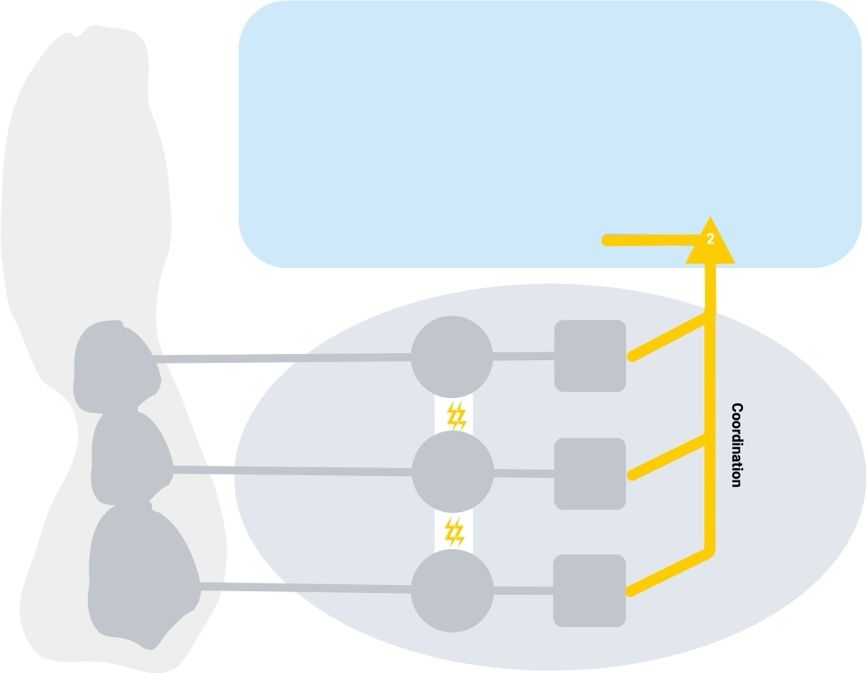
Coordination - System 2
System 2 as a dampener of oscillations
The pragmatic view of System 2 is horizontal or peer-to-peer coordination. This is the least expensive and fastest way of resolving conflicts, but it is more than that. In the cybernetic sense, it is a dampener for oscillations.
System 2 monitors the activities of the operational units (system 1) and intervenes to prevent excessive fluctuations. It coordinates with system 3, the operational management, if necessary.
One example of this is regulating traffic flow in a city.
- When traffic at an intersection gets too heavy, traffic lights can be adjusted to optimize traffic flow and prevent congestion.
In this case, the traffic light system acts as an oscillation damper by regulating traffic flow and maintaining a stable system. [3, 4]
System 2 dampens oscillations by:
- Gathering and analyzing information about the state of the system.
- Taking corrective action to bring the system back into balance.
- Coordinating communication between the various parts of the system.
The effective design of System 2 is critical to a system's viability because it helps ensure the system's stability and efficiency.
Not dominant, but immensely important
System 2 operates in the vertical plane of the management level and is outside the usual "command channel"
Here are some important characteristics of System 2:
Necessary but not dominant: System 2 is essential for the viability of a system, but it does not dominate the entire system. Its importance lies in its ability to dampen oscillations that could endanger the stability of the system.
Difficult to recognize: System 2, unlike other VSM subsystems, has no clear equivalents in traditional management thinking. This makes it difficult to understand and identify its role and function in an organization.
Commonly flawed: Due to the lack of understanding of System 2, flaws in its design and function are common. This can lead to problems in the operational area because oscillations are not effectively dampened.
Responsible for converting operational data: System 2 acts as a converter that converts operational data into information for the management level. It filters the data generated by the operational units of System 1 and forwards the relevant information to System 3.
Can operate in different dimensions: System 2 can operate in different management levels of an organization, such as in finance, manufacturing, retail, and government.
System 2 strengthens autonomy
System 2' ensures coherence, and settling, or better, avoiding conflicts while preserving the autonomy of the operational systems as best as possible.
System 2 is therefore committed to strengthening the individual operating units. Specifically, this includes strengthening their ability to organize themselves.
System 2 Tasks
System 2 is not an entity in the company; it is a whole set of things that support the operational units and ensure stability, for example:
- Software systems
<!-- -->
- Room booking
- Software version management
<!-- -->
- Roles of groups and individuals
<!-- -->
- Secretariat
- Steering Committees
- Moderators and coaches
<!-- -->
- Documents
<!-- -->
- Guidelines
- Corporate design standards and templates
<!-- -->
- Meetings
<!-- -->
- Planning and review meeting
- Retrospectives, lessons learnt
<!-- -->
- Culture
<!-- -->
- Language and manners
- Standards
System 2 is critical to the organization's ability to achieve adequate self-organization at the grassroots level. This task falls back to management if mechanisms are lacking or do not function well here. This, in turn, leads to a high burden of high time consumption, which leads to insufficient time for the strategic tasks and the work on the system.
Coordination of the lean value stream
The various processing stations require a coordination function.
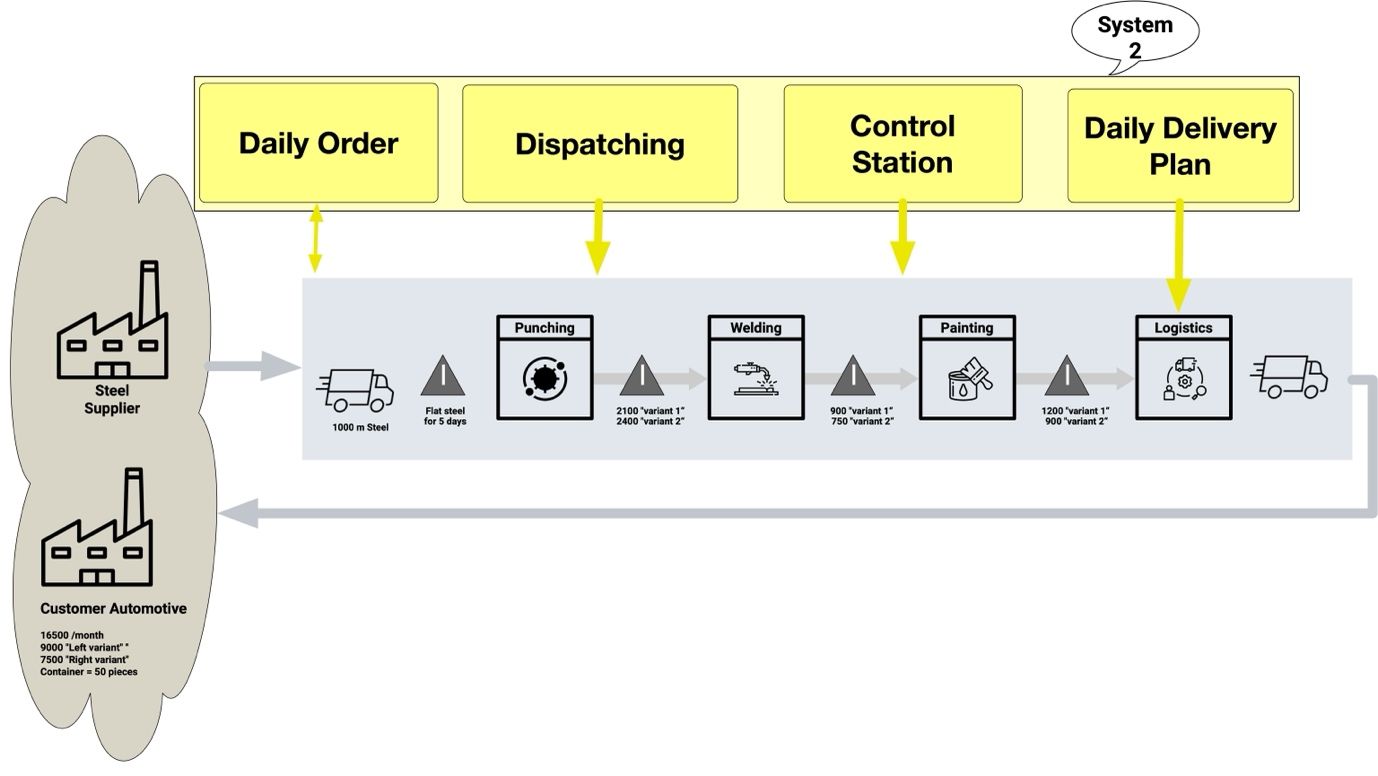
The value stream with exemplary coordination functions
System 3: Optimization and auditing
Inside and Now - System 3
Reflection, improvement, synergies
System 3, the operational management, relieson the ability of the individual systems 1 to organize themselves and coordinate with the support of the mechanisms of system 2.
The task of System 3 is to provide an overall view and initiate improvements based on this balanced view of the system as a whole and Systems 1. To do this, it must communicate with System 2 and the local control functions of the individual Systems 1.
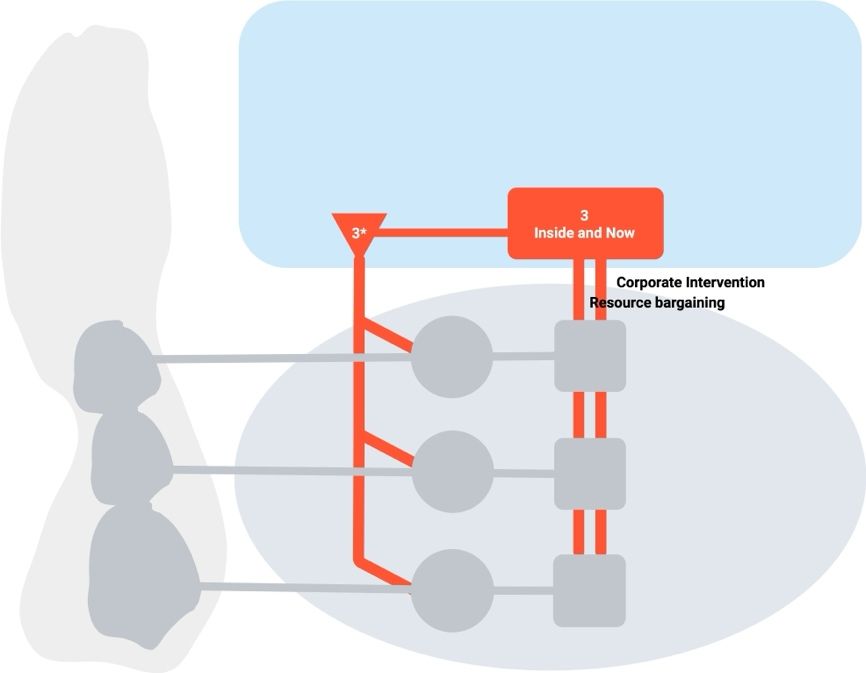
Stafford Beer describes this system as "Inside and Now": it takes care of the organization's inner workings and functioning and drives improvements.
System 3 thus creates the environment and context for effective collaboration between the individual operational systems.
The channels between System three and Systems 1
The operational systems organize themselves as much as possible and use the services of system 2 for coordination. This is the most effective way to derive this priority directly from Ashby's law. Why is a potentially overarching operational management still necessary?
Pure self-organization between the operational systems is not always sufficient. Intervention may be required when conflicts arise over resources or general policies must be implemented. For this purpose, system 3 has two vertical channels to its systems 1: resource negotiation and accountability and intervention channels.
Resource Bargaining and Accountability. This channel discusses goals, agrees on plans, and allocates the corresponding budgets or resources. It is also used to demand accountability for the resources used.
**Corporate intervention. This channel can restrict the autonomy of the operational systems. In other words, it is a channel for explicit instructions used only in exceptional cases---**but it must be available for emergencies.
The functional organization of the company
In an organization, many functions strengthen the synergy in the organization and embody a concrete implementation of the company's System 3:
- Finance
- Marketing Management
- Controlling.
It seems obvious to classify these functions as a whole in system 3. However, if we take a closer look, the picture becomes more differentiated. For example, we will find marketing functions in various places: in system 3, system 2, the communication channel with the customer, and more.
This is because the cybernetic view with decisions, control, and communication brings other structures to the fore. It is different from the business administration view, with the organizational structure and process organization. This orthogonal view is an essential element for the strength that lies in the use of VSM.
Lean: production control
Here, we see the typical elements of daily production control. Some elements communicate with the environment---in this case, the customer---while others are for internal coordination, such as assigning employees to workstations when others are absent due to illness.
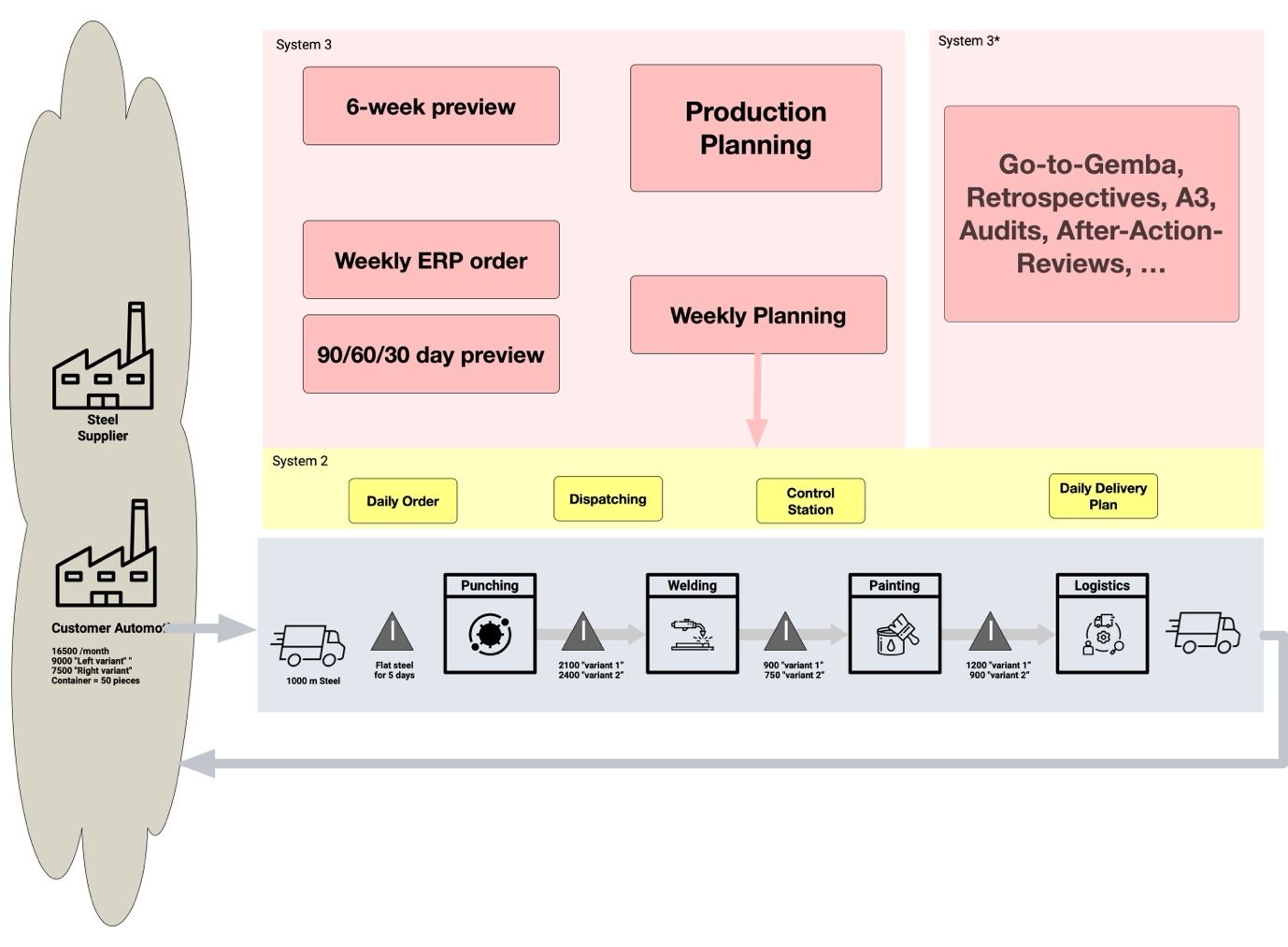
Value stream with operational management
System 3*: Research and auditing
Another mechanism is System 3* ("three star"). This is a pure research mechanism with which System 3 collects direct, unfiltered information about operational System 1 as close to real-time as possible.
Examples of System 3* mechanisms include a number of well-known mechanisms in all kinds of management methods, such as:
- Gemba as in Lean Management or "managing by walking around
- Revision procedures
- Direct contact with customers
- Surveys
The function of this system is twofold: on the one hand, it prevents blind spots for central operational management through the conscious or unconscious omission of information in reports. Second, it provides a richer context for interpreting facts when management has direct ground contact and a view out of its silo.
One pitfall is treating the 3* mechanisms as additional controlling mechanisms - they are meant for information gathering, not direct control.
The Role of System 3*
By providing additional information that is not included in the routine reports, system 3* enables a better understanding of the operational situation and supports system 3 in taking appropriate action.
In our examination of system 3, we saw that three information systems converge there.
The first block is formed by the vertical channels that are transmitted from system 1 to system 3. These are, on the one hand, information about the guidelines of the organization and the operating instructions to the operational units and, on the other hand, information about the internal situation of the organization, including the algedonic signals that warn of extreme risks.
The second block of information is passed on, which has been collected and filtered by System 2.
This information relates to aspects of homeostatic control of the internal environment, but in the context of more or less predetermined operating routines.
However, information is also needed that is not contained in these channels. This must be taken up by system 3* and represents the third block of information that reaches system 3.
System 3* is not limited to the transmission of information, but must also process it. Each operational unit has its own audit mechanisms that generate information about synergies for the totality of the units that make up system 1.
The purpose of System 3* is to ensure that the information between System 1 and System 3 is complete. This is achieved through audits (e.g. quality audits, opinion polls, adherence to accounting procedures, etc.), work studies (industrial engineering), operations research, surveys and special studies, etc. [6]
System 3 in comparison to other systems
Unlike system 2, which smoothes out oscillations between operational units, system 3* is concerned with gathering information that may be missing from formal reporting structures.
While system 4 focuses on the external environment and the future, system 3* deals with the internal workings of system 1.
System 3* is a means to obtain a more complete picture of operational reality.
Practical examples for system 3:*
- Audits: quality audits, financial audits, safety audits
- Surveys: employee surveys, customer surveys
- Special investigations: investigations into specific problems or incidents
- Data analysis: analysis of operational data to identify trends and patterns.
System 4: Reconnaissance
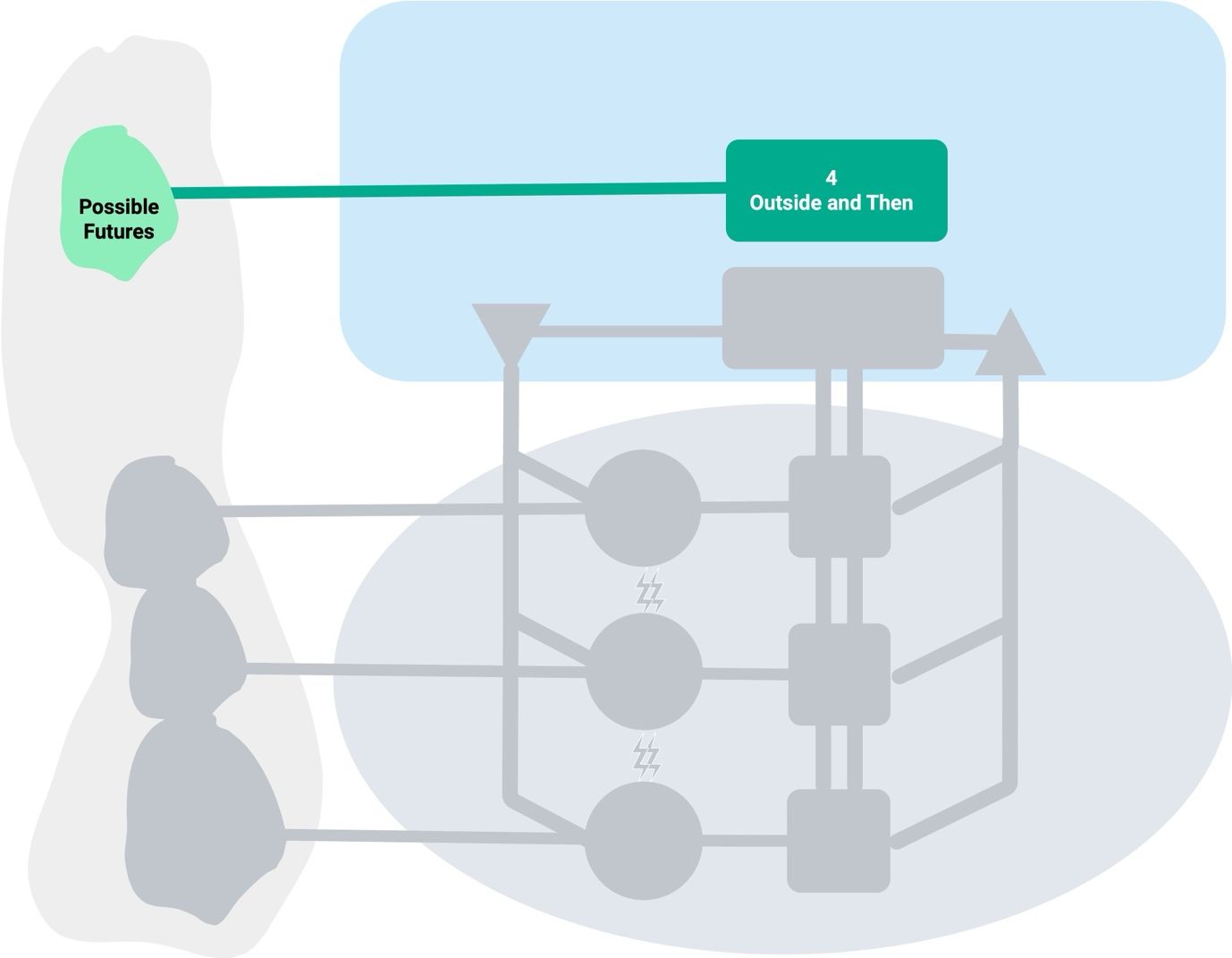
The function of the System 4
With the control systems discussed so far, we have a functioning organization - if there were no environmental changes. Systems 1-3 provide the mechanisms to stabilize and keep a company running. However, we have not yet seen provisions that respond to, or even anticipate and trigger, deep changes.
We find these provisions in system 4.
While system 3 turns inward and focuses on current activities and the existing organization, system 4 turns its gaze outward and into the future---in the words of Stafford Beer, it is the system "Outside and Then."
Examples of System 4 functions include
- Research and development
- Observation of the competition
- Strategic personnel planning
- Working in associations and networks
- Strategy development
At this point, at the latest, it becomes clear that these examples have both professional and financial consequences. Thus, it represents a cross-cutting function through traditional organizations' typical division of labor.
Possible futures
One concept is still worth mentioning: people talk about a specific extension of the environment, the "possible futures." This is similar to working in scenarios, but it is a valuable perspective to explicitly put these futures in the context of the environment or ecosystem.
Conflicts and complementary views: Systems 3 and 4
The diagram shows the strong interactions between systems 3 and 4, which, in a way, represent complementary views: on the one hand, the forces of the existing that want to keep the organization running - that is the core function of the company and, on the other hand, the admonishers that something has to change because otherwise there is a threat of standstill and loss of significance.
The operational side - System 3 - points out that they ultimately make the money, and the changemakers' side admonishes that the others are sleeping through the future. Both have valid points and the productive tension results in a healthy mix of stability and further development.
However, this conflict can also escalate or factions form that dig in and no longer exchange ideas with each other. Then, a moderator becomes necessary to balance the different interests. This is where System 5 comes into play.
Lean: Innovation, Strategy
System 4 takes care of planning and considering external factors.
We introduced a new element in the representation of the environment and explicitly mentioned competition as an environmental factor.
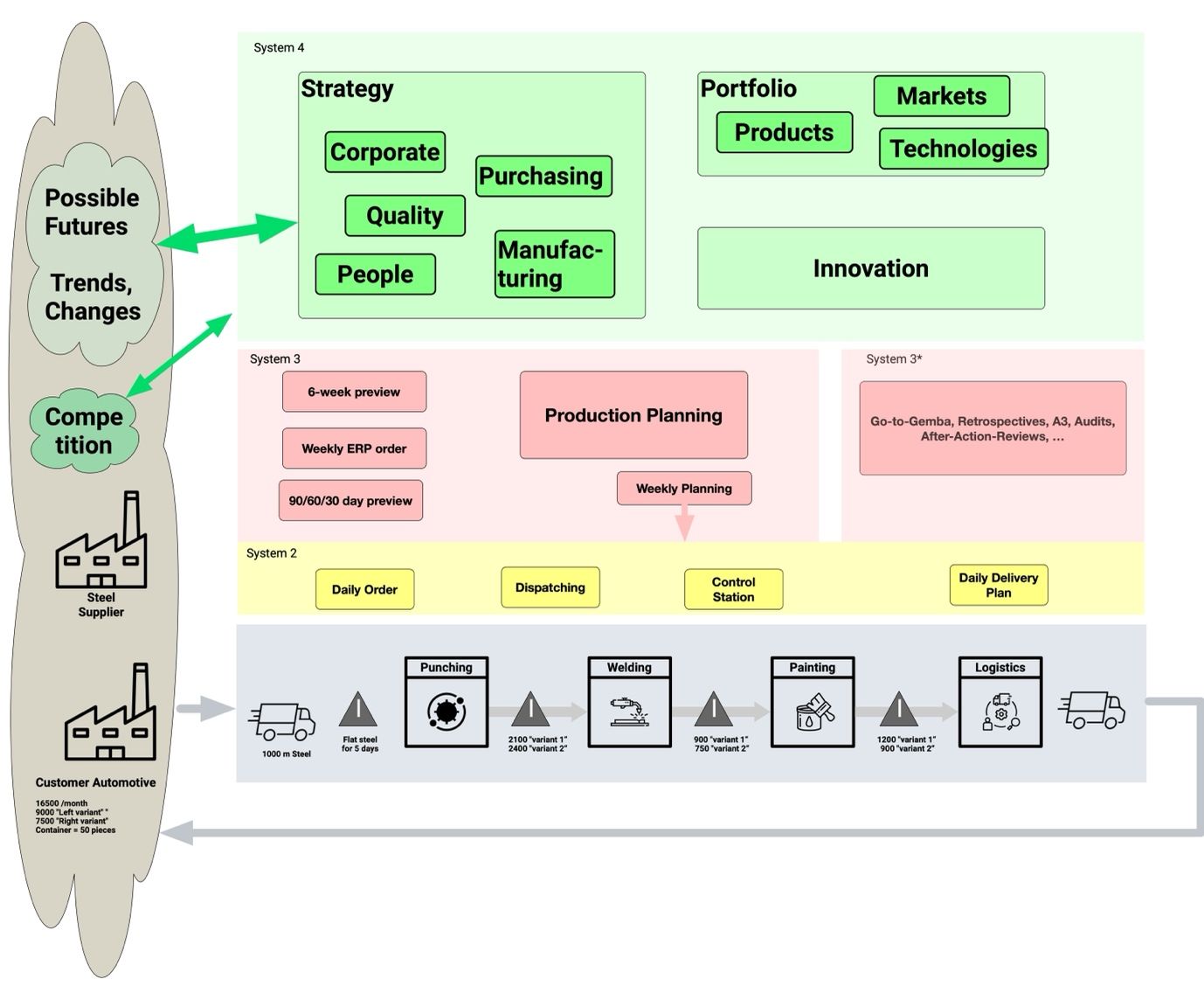
Value stream with Systems 1-4
System 5: Identity
Identity guardian
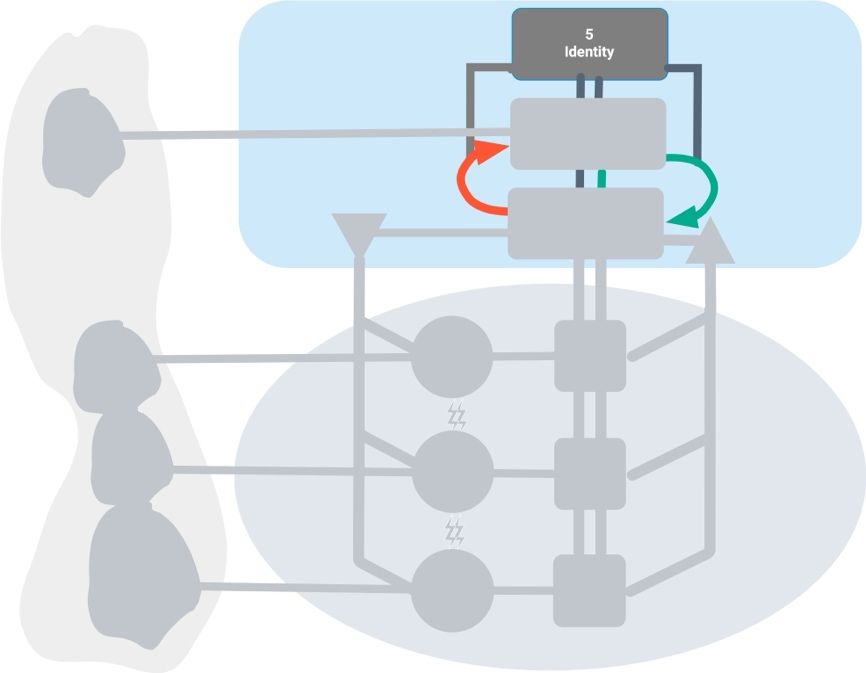
Identity- System 5
System 5 is the ultimate moderator, boss, and decision maker.
Its function is to represent a north star, a general direction, coherence, and an identity.
This then provides a basis for moderating conflicts, for example, between System 3's short-term goals of operational management and System 4's longer-term goals.
If you look at the VSM diagram, you can see that system 5 has access to systems 3 and 4 and the channels connecting these two. This represents the logical fact that identity must resonate in all decisions.
The system also has an ultimate veto or instruction function to ensure that local decisions and actions do not thwart the global purpose. Another channel, the Algedonic channel, is needed to perform this function safely.
The Algedonic Channel
Algedonic is an artificial word for the VSM, a mixture of pain and reward.
As an emergency channel, it ensures senior management is informed of threatening situations or extraordinary opportunities in real time and can respond accordingly.
Lean: Identity
Finally, system 5 ensures identity: Being viable means not only surviving but also maintaining an identity and pursuing a purpose.
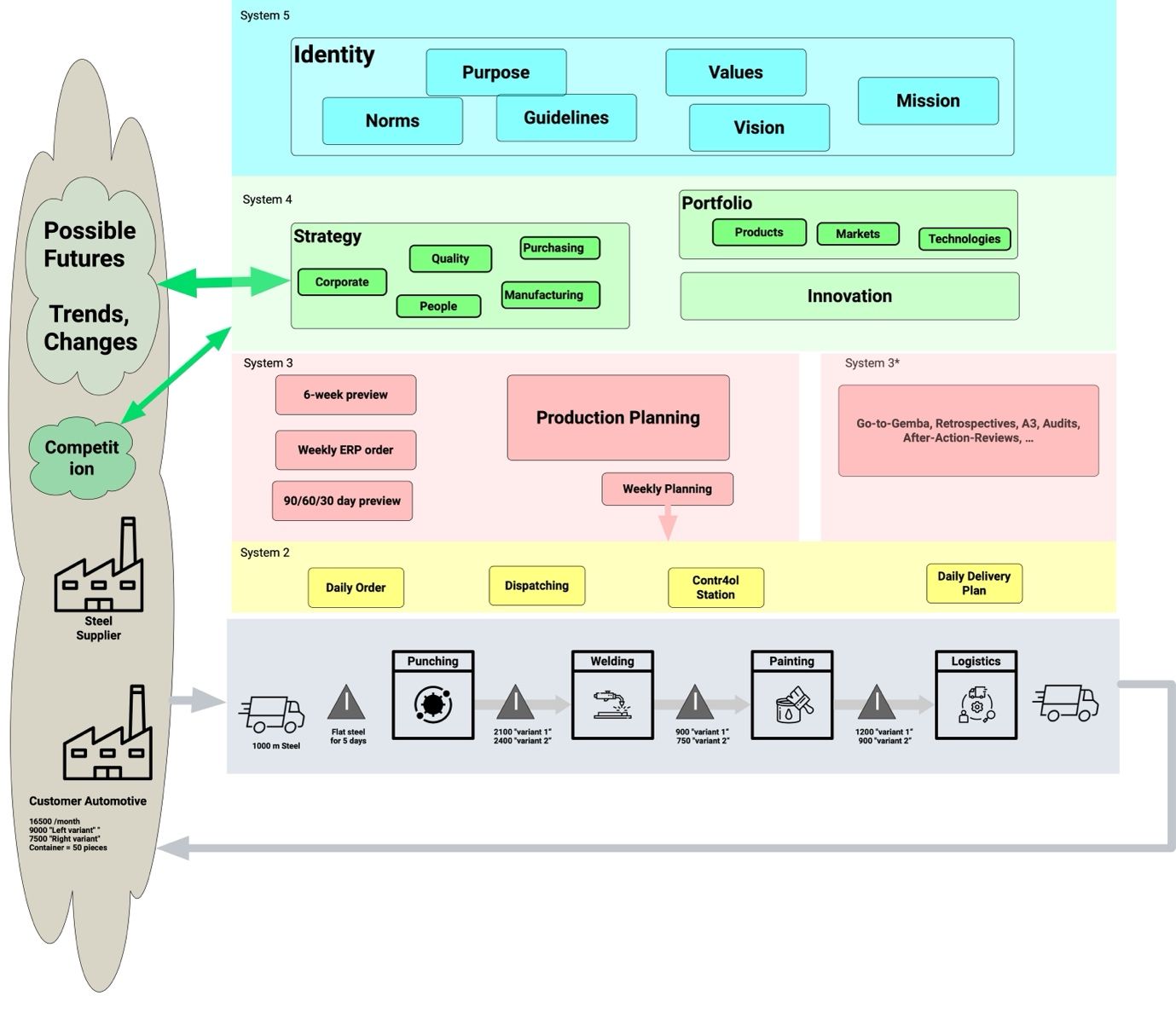
Complete picture of the VSM for the value stream
Conclusion
The description of the value stream, which is the core of Lean, corresponds directly to System 1 of VSM. Both Lean and VSM offer many more details and tools.
One can clearly see the difference in VSM's focus from Lean's: it has a different view. VSM structures the various tasks that arise pretty differently than they occur in Lean's value stream view or in the company's organizational chart. This results in new insights and design possibilities, and VSM uses these to provide precise diagnostic tools.
Mapping
Compared to the previous abstract system model, it becomes clear what a concrete company analysis could look like. Do not forget that VSM takes care of decision and communication structures and thus offers an additional view of the company's structure.
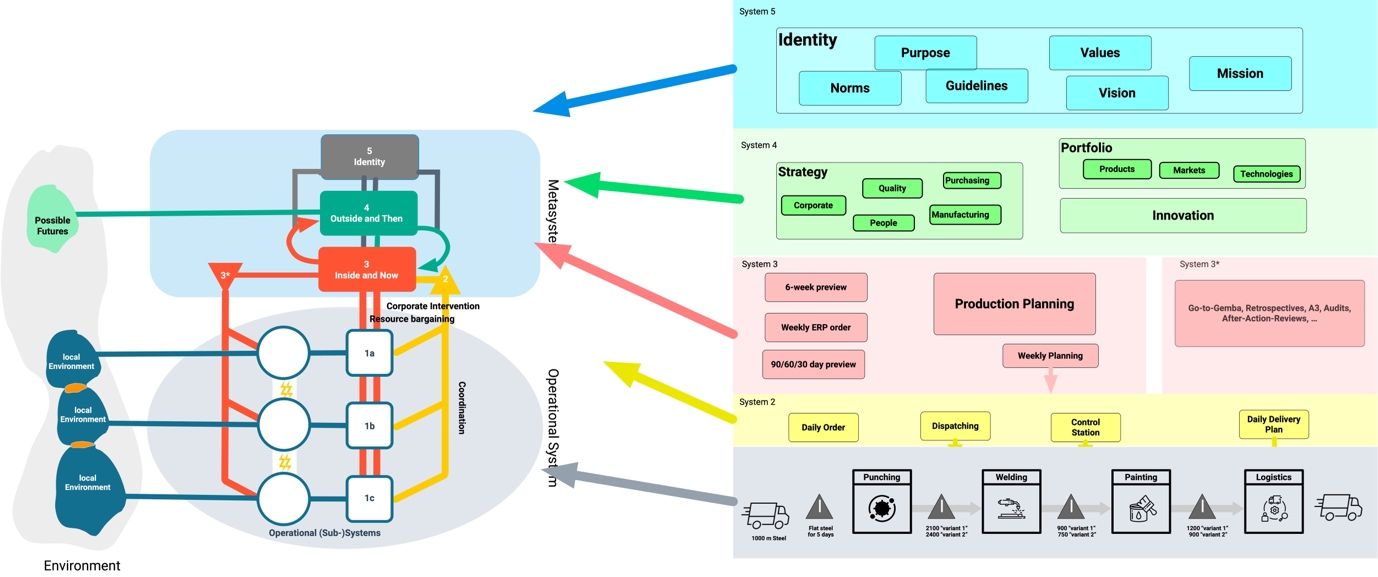
Assignment to subsystems