
The Ooda Loop
What is OODA
We structure our steps according to the logic of the OODA Loop.
The OODA Loop is a strategic tool developed by military strategist and United States Air Force Colonel John Boyd. OODA stands for Observe, Orient, Decide, and Act. It's a decision-making process to help individuals and organizations operate effectively in competitive environments. The loop emphasizes the importance of adapting quickly to changing situations through a continuous cycle of interactions.
Typically, it is drawn like this:
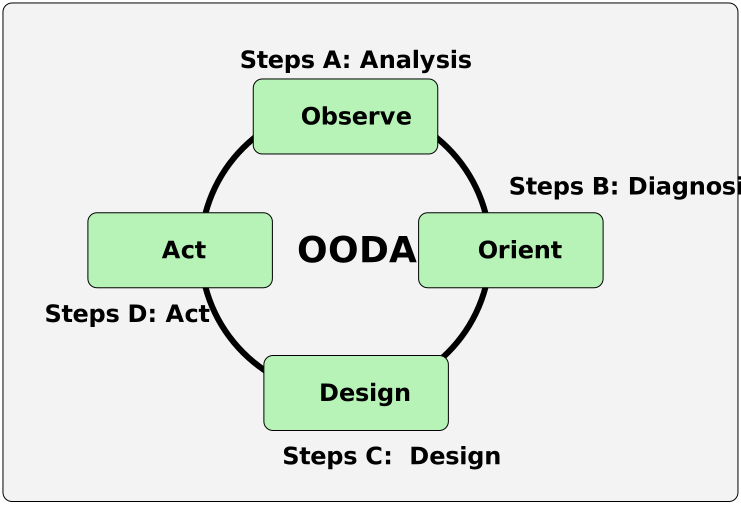
- Observe or Sense (Analysis) - Gathering information and understanding the current environment and situation: In Observe mode, you focus on understanding the current situation. This section helps you dissect and comprehend an organization's various elements and dynamics, paving the way for insightful analysis.
- Orient (Diagnosis) - Analyzing and using the information to update your view of reality. While the analysis does not directly imply an assessment, the main focus of the diagnosis is developing an opinion about the findings.
- Decide (Design) - Making decisions based on observations and orientation: Finally, we delve into organizational design. This part guides you through the critical decisions involved in proposing changes and improvements to an organization's structure and processes, utilizing the principles of VSM.
- Act (Ways of Change) - Taking action to implement the decision: Last, we choose a procedure to implement the findings. This can mean a traditional change process or an iterative approach. We discuss some of the options and the reasons why you would choose one over the other.
After taking action, the loop restarts with observation to assess the actions' success and to react to any changes in the situation.
The process helps to control the "blast radius," i.e., the impact of an intervention. The loop allows interventions to be treated as experiments. It is intended to be performed rapidly and continuously, allowing quick reactions and flexibility in response to a situation's dynamics, leading to improved strategic outcomes.
The OODA Loop is not a Loop.
What looks like a deterministic circular process in this illustration is much more complex and open. In any case, the OODA loop is not a loop.
It is an open system: you can enter and exit it anywhere.
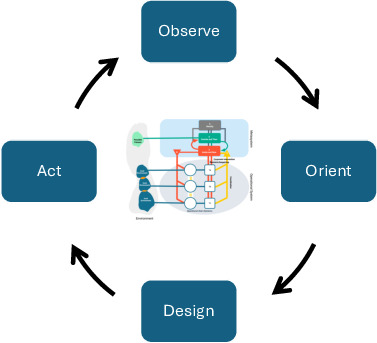
OODA is not a Loop
Any "phase" can become current, depending on the situation. This dynamic nature keeps you engaged and active in the decision-making process. A simple example would be the famous hand on the hob. This certainly does not lead to you orienting yourself, designing the reaction, and then taking your hand off the hob. Instead, it is a sequence of sense (aka observe) -> act.
But there is no automatic because of pain here, either. I modify the example slightly so that the Christmas tree burns. I may grab it anyway and throw it out of the patio door.
In Boyd's view, there are many loops at different speeds simultaneously; the opponent reacts in the same way and, in turn, forces me to respond.
Compared to the fighter pilot Boyd, who had to reckon with constantly changing reactions in a fraction of a second, we have a comparatively simple situation: the object of our observation does not bite back.
Nevertheless, one aspect is important: OODA is a holistic checklist and reminds us not to run off at the first observation but to invest time, willpower, and energy in assessing the situation. This investment is valuable and can lead to more informed decisions.
OODA as a set of Views
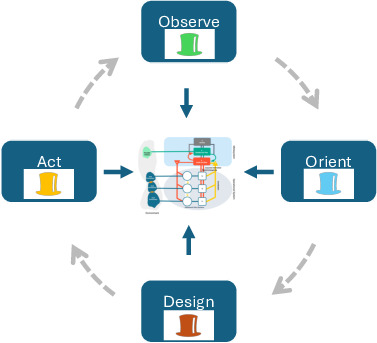
Perhaps a better picture than a loop is a situation in which we continuously view the system in focus with different "hats," i.e., perspectives, and are always ready to integrate contributions from every perspective.