Part 1 - The Perfect Storm
Executive Overview: Traditional management models are failing because they were built for a predictable world that no longer exists. Part 1 serves as an urgent diagnosis, exposing why your competitors are faster and why your green dashboards are a red flag, making the case for a new, adaptive operation model.
Diagnosing the Need for a New Way to Lead
The old maps no longer work
You feel it in your strategy meetings. The forecasts seem fragile, the five-year plans feel obsolete before they’re even approved, and nimble competitors seem to emerge from nowhere, capturing value while you're still stuck in committee. The hard-won management principles that built your career don't seem to have the same bite they once did. It feels like the ground is shifting beneath your feet.
You're not wrong. The maps we've used to navigate the business world for decades are failing us. Part 1 of The Tautai Principle is a clear-eyed diagnosis of why. Before we can build a new kind of organization, we must first understand the fundamental forces that have made our old models a competitive disadvantage. It’s a journey out of the "Land of Predictability" to learn why we must now navigate by the stars.
Why Your Strategy Is Too Slow (Chapter 1)
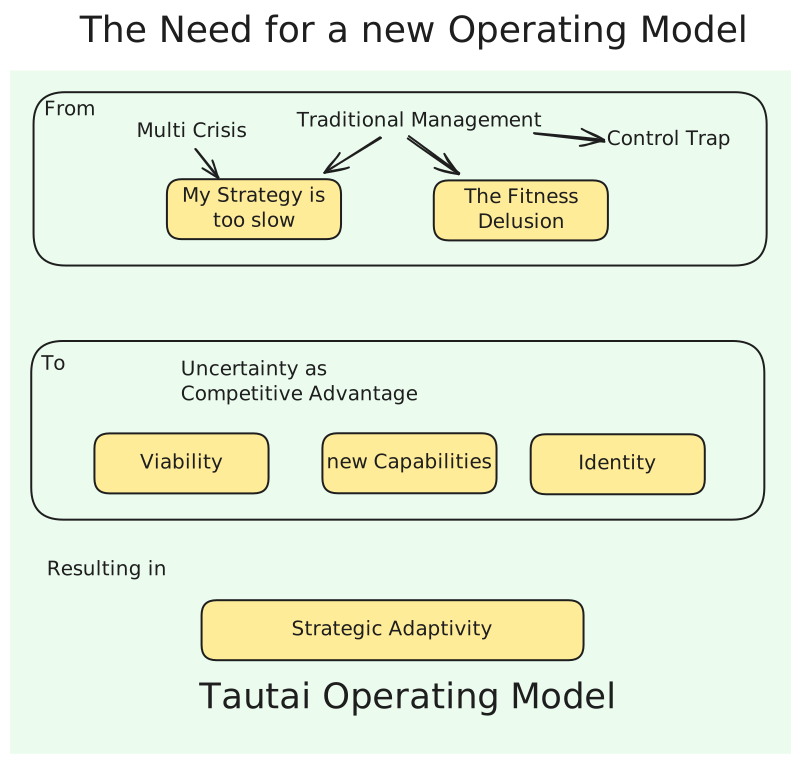
The first part of the diagnosis confronts the defining challenge of modern competition: the speed gap. Your competitors aren't necessarily smarter; they are faster. They sense and respond to market shifts while you are still analyzing and planning.
We argue this isn't a temporary disruption but the result of a "perfect storm" of three converging forces:
- Geopolitical Chaos: Stable trade rules and supply chains have been replaced by constant volatility, making multi-year plans obsolete overnight.
- The Multi-Crisis Environment: Interconnected challenges in climate, resources, and talent demand resilience, not just efficiency.
- AI Acceleration: Cognitive automation is fundamentally changing work and customer expectations faster than traditional strategy cycles can cope.
In this new reality, the traditional "predict-and-control" playbook becomes a trap. Our addiction to prediction, our delusion about "best practices," and our linear thinking create a dangerous illusion of control while faster competitors build superior response capabilities. Chapter 1 of the the TauTai Principle introduces the metaphor of the Tautai, the ancient Polynesian wayfinders who navigated the vast Pacific not with fixed maps, but by reading the living signals of the ocean—the waves, the stars, the birds. They understood that their only stability came from constant adaptation.
The Fitness Delusion (Chapter 2)
The diagnosis goes deeper in the second chapter, challenging the very definition of organizational success. Your dashboard might show healthy numbers—strong earnings, stable market share—but these are lagging indicators. They create a "Fitness Delusion," masking deep vulnerabilities that are about to surface. Optimizing for yesterday's definition of success often destroys your ability to compete tomorrow.
Chapter 2 introduces a more powerful standard for success: Viability. This isn't just about current performance; it's a holistic measure of your organization's capacity to adapt, endure, and thrive through constant change. Viability stands on four interconnected pillars:
- Adaptability: The ability to change before you are forced to.
- Resilience: The capacity to turn setbacks into advantages and maintain coherence through change.
- Robustness: The strength to remain reliable and effective under stress.
- Operational Excellence: The disciplined execution that creates the value and resources needed to fund adaptation.
Balancing these four pillars, anchored by a clear sense of Identity, is what it truly takes to win in an unpredictable world.
The Unmistakable Conclusion: A New Journey Is Required
By the end of Part 1, the case is clear. The comfortable "Land of Predictability" is gone. Our reliance on control, prediction, and outdated metrics is no longer a source of strength but a critical vulnerability.
Understanding why the old maps fail is the essential first step toward learning a new way to navigate. This diagnosis sets the stage for the rest of the journey, moving from understanding the problem to building the capabilities—the vessel, the crew, and the navigational tools—needed to master an uncertain future.